
The pharmacist usually notices first
Dispensing history is one of the most continuous records in healthcare. NeuSymbol reads what it shows about how a patient is actually doing.
A record that is rarely read as a whole
A patient may see four different clinicians across three systems and fill every prescription at the same pharmacy. Dispensing history is frequently the most complete longitudinal record that exists for that person, and it is almost never read as a clinical signal.
Changes in refill timing, additions and substitutions, and the accumulating pattern across therapies all carry information about whether a treatment is working and whether an underlying condition is progressing.
Pharmacists observe this. They frequently raise it. What has been missing is a mechanism that turns the observation into something a prescriber can act on.
Response, read from dispensing
Patterns consistent with a therapy not achieving its intended effect are surfaced for pharmacist review, supporting a documented conversation with the prescriber.
Patterns worth a second look
Certain combinations and sequences across therapies are consistent with conditions that are commonly recognized late. These are surfaced as a prompt for evaluation, never as a conclusion.
Supporting the referral
Output is structured so that a pharmacist has a defensible basis for recommending evaluation, rather than an instinct that is difficult to convey in a short call.
Inside the network, not outside it
The system is installed within the pharmacy organization’s own environment. Patient information is not transmitted to Reltronic and is not shared between organizations.
NeuSymbol Beacon is the typical configuration for individual and regional sites; NeuSymbol Meridian for national networks operating centrally.
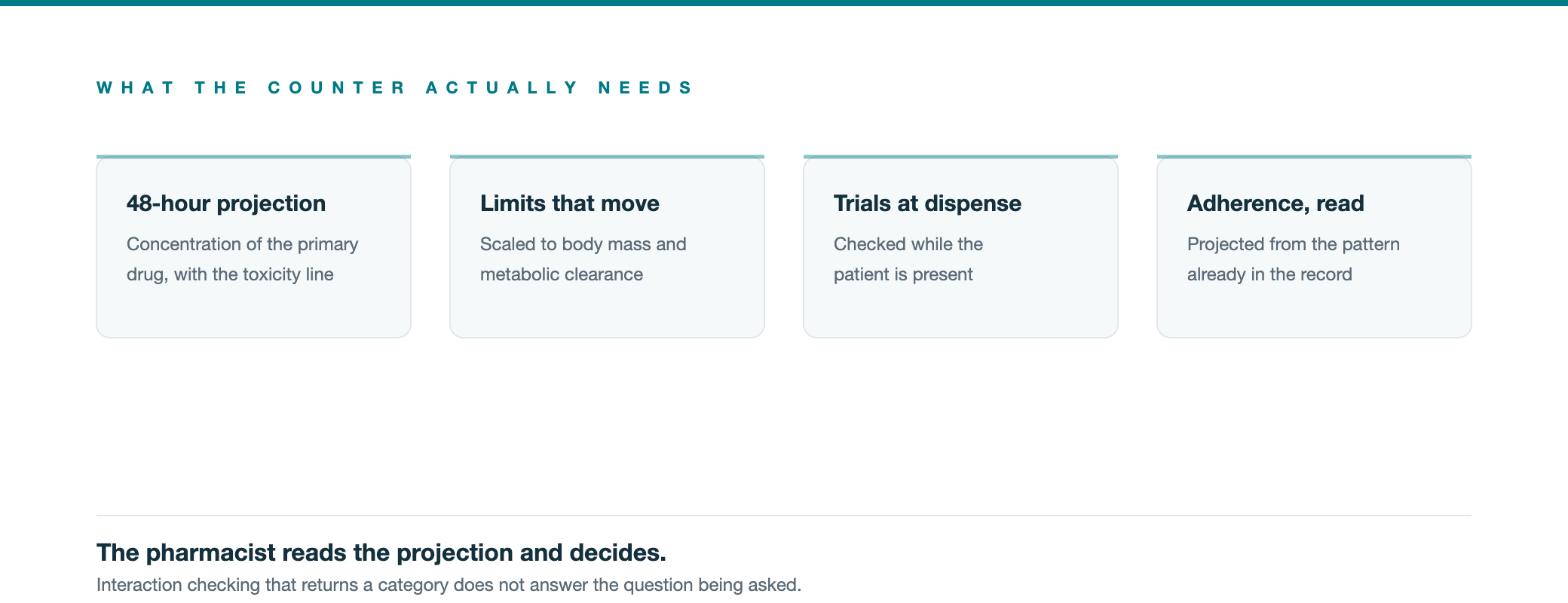
What the counter actually needs
Interaction checking usually compares a new prescription against a list and returns a category. It does not tell the pharmacist what will happen to the concentration of the drug that matters over the next two days.
The platform projects the primary therapy’s concentration across the following forty-eight hours, with the toxicity boundary drawn on the same axis. Where a secondary medication or an over-the-counter agent competes for the same metabolic pathway, the effect on clearance is visible rather than inferred. The pharmacist reads the projection and decides.
Limits that move with the patient
A dose that is safe for an average adult is not safe for every adult. The platform scales the toxicity boundary to the individual, using body mass together with the genetic markers that determine fast or slow metabolic clearance. A standard dose that would accumulate in a pediatric patient, or in an adult with compromised clearance, is shown against that patient’s own boundary rather than a population one.
Trials, at the point of dispense
Patients with rare and difficult conditions are frequently eligible for studies nobody screened them for. The platform checks the patient’s profile against active inclusion criteria at the counter, which is the one moment the patient is present and the question can be asked.
Adherence read rather than assumed
Dispensing intervals carry information about adherence that generally goes unread. The platform projects the clinical consequence of the pattern already in the record, so a conversation about compliance can be specific rather than general.