
Reltronic works with academic medical centers, independent research organizations, patient foundations and advocacy groups. Those organizations set their own research agendas and keep ownership of their own data. Reltronic supplies the infrastructure and the software, and takes no rights in what a partner discovers.
Regal Intel
Regal Intel, Inc. is a 501(c)(3) public charity operating as a research consortium. It convenes rural and urban clinical networks, academic investigators and patient-led foundations around specific disease programs, and it is the partner through which several of those programs reach the institutions holding the relevant records.
Its flagship program is Project JANUS. It is a multi-center initiative for patients whose rare genetic disease looks like a common chronic condition. They are carried for years under a diagnosis that does not explain their course. A second program works with patient-led rare disease foundations to develop registry and natural history data to a standard a regulator will accept.
Both depend on computation reaching records that cannot be moved. That is the requirement Reltronic infrastructure was built to meet, which is why the two organizations work together.
How these alliances work
Reltronic supplies infrastructure and software. The technology is deployed inside the partner institution, which means a research collaboration can begin without the negotiation over data transfer that ordinarily consumes the first several months of one. There is no data use agreement to draft for the movement of records, because no records move.
Partners set their own research agendas, select their own questions and retain their own findings. Reltronic does not direct research, does not co-author by default, and does not acquire rights in what a partner discovers. The company supplies the instrument; the partner does the science.
This has a practical consequence that partners tend to notice before anything else. The review work that normally precedes a multi-site study gets smaller. Most of that review is spent on transfer, subprocessors and jurisdiction. When the data never moves, those questions have nothing to be about.
Who Reltronic works with
Academic medical centers
Investigators with a defined question and a patient population already under their care. The platform operates on records the institution already holds, so a study can be scoped against real counts rather than against an estimate, and feasibility can be answered before a protocol is written.
Independent research organizations and consortia
Organizations coordinating work across sites. The obstacle is rarely scientific. It is assembling comparable data from institutions with different systems, different consent postures and different appetites for transfer.
Patient foundations and registries
Organizations holding years of registry and natural history data from their own communities. They need it developed to a standard a sponsor or a regulator will accept. The community gave that data to the foundation. It should stay with the foundation.
Ownership, stated clearly
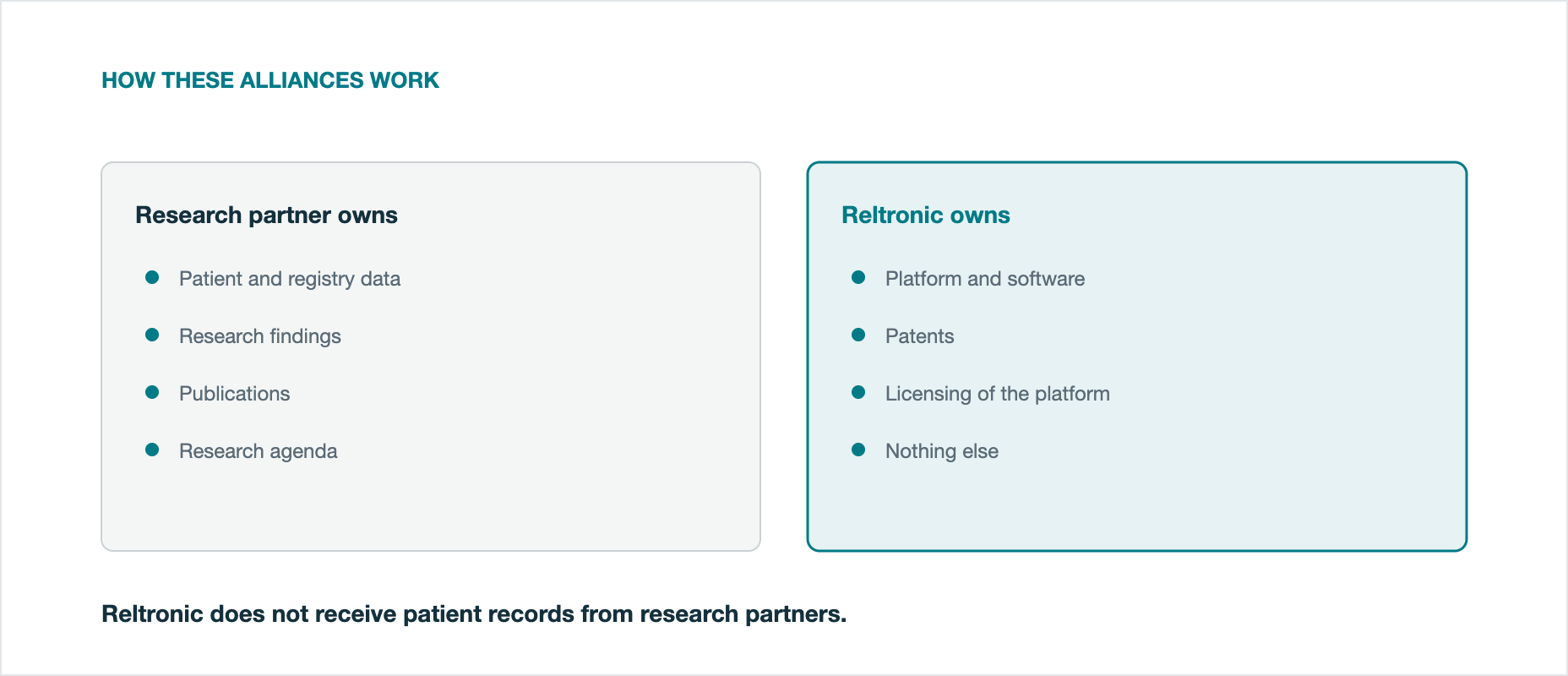
The division below is the same in every alliance and is written into the agreement rather than left to custom.
- The research partner owns patient and registry data, research findings, publications, and the research agenda itself.
- Reltronic owns the platform, the software, its patents, and the licensing of the platform. Nothing else.
Reltronic does not receive patient records from research partners. There is no configuration of the platform in which it does, and no commercial arrangement that would change it.
What a partner is not asked for
Several requests are common in this field and are absent here. Stating them explicitly is faster than answering them one at a time.
- No transfer of patient records to Reltronic, in identified or de-identified form.
- No rights in research findings, and no default co-authorship.
- No exclusivity, and no restriction on working with other technology providers.
- No right for Reltronic to publish, cite or reference partner results without written agreement.
- No standing access by Reltronic to the institutional environment. Support access is requested, scoped, time-limited and logged in a record the institution controls.
How an alliance begins
It begins with a question rather than a contract. A partner brings a defined clinical or research question and a population. Reltronic assesses whether the platform can address it against the data the institution already holds, and says so plainly where it cannot. Where the answer is that the platform adds nothing to a particular question, that is a useful result and is reported as such.
Where it can, the work is scoped, the security review begins at that point rather than at the end, and the agreement follows the scope rather than preceding it.
On publication
Partners publish. Reltronic asks only for the opportunity to review a description of the platform for technical accuracy before submission, and to correct an error of fact. That review carries no right to delay, alter or veto a finding, including a finding unfavorable to the platform.
A partner who reports that the platform did not help is describing a real result, and the ability to report it is what makes the favorable results worth anything.