
The right therapy reaching the right member
NeuSymbol surfaces response patterns that may warrant reassessment of high-cost treatment, and presents changes in condition across encounters for clinical review, inside the health systems that hold their records.
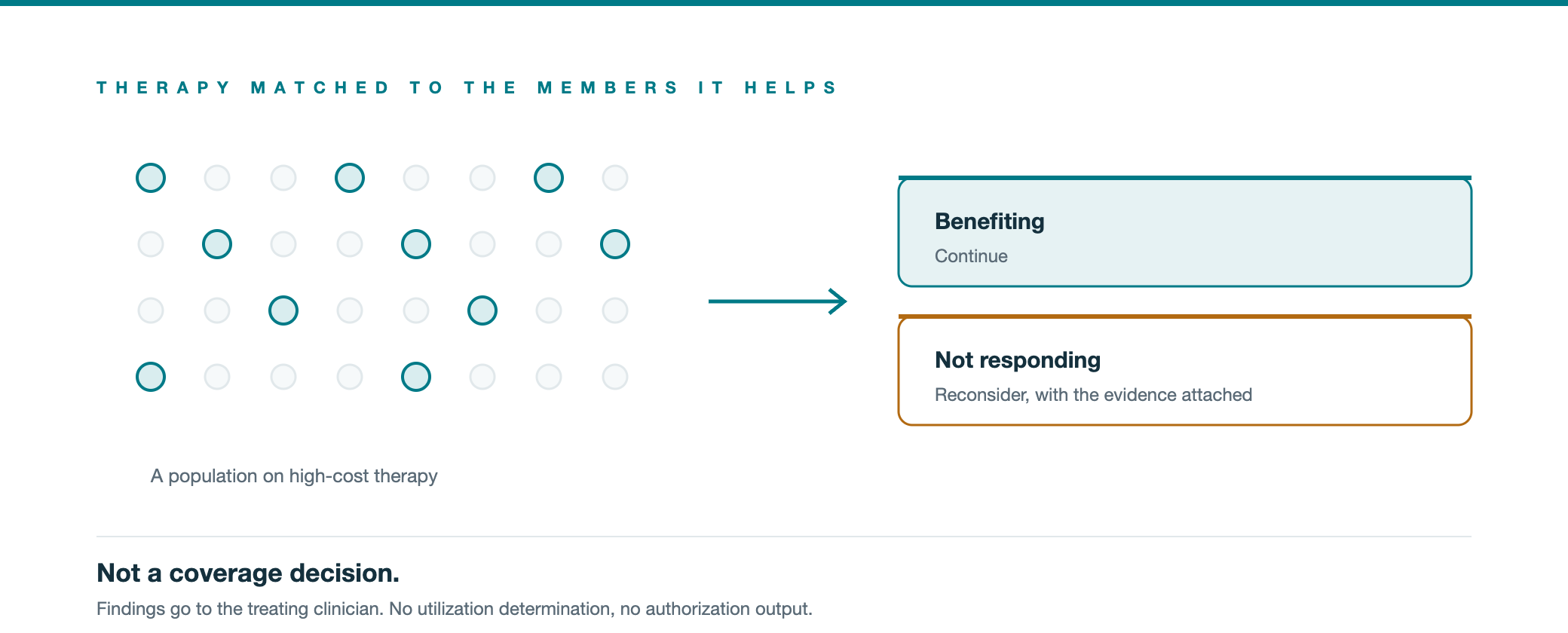
Therapy matched to response
High-cost therapies benefit some members substantially and others not at all. Where a therapy is not working, continuing it is expenditure without clinical return, and it delays the alternative that might have worked. Identifying those members early serves the member and the plan at the same time.
Progression before the event
Members who arrive in intensive care with a complex or previously unrecognized condition have usually been visible in the record for years. Recognizing that trajectory earlier is where both the clinical benefit and the avoided cost sit.
What this is not
This is not a utilization management tool. It does not deny, restrict or adjudicate anything, and it produces no coverage determination.
The platform surfaces clinical findings to treating clinicians inside the health system that holds the record. Decisions about a member’s care are made by that member’s clinician. A plan cannot use it to override a clinical decision, because it produces no instrument for doing so.
Reltronic’s position is that the value here is entirely in matching treatment to the people it helps and recognizing deterioration earlier. A product that reduced cost by obstructing care would fail clinically, fail reputationally, and Reltronic would not build it.
Engagement model
Plans and risk-bearing organizations most often sponsor deployment within provider networks where they hold shared risk, particularly in rural and community settings where the platform’s ability to work without local case precedent matters most.
The plan receives population-level analysis. It does not receive patient records, which remain with the treating institution throughout.
The arithmetic of paying earlier
High-cost therapy is usually assessed against a plan year. The disease is not on a plan year. That mismatch is where most of the disagreement between a payer and a prescriber actually sits.
What an unmanaged trajectory costs
The platform models the projected liability of a condition continuing on its current course against the cost of intervening now, both over a multi-year horizon. The figures come from the member’s own record rather than from population averages, which is what makes them arguable in a specific case.
Substantiating medical necessity
A denial usually rests on the absence of evidence that this member needs this therapy. The platform presents the member’s projected untreated course alongside the projected treated course, with the underlying encounters attached to both. It does not produce a coverage determination, and it is not intended to.
Milestones that can be verified
Value-based agreements fail on measurement more often than on principle. The platform ties agreed efficacy milestones to a defined change in the member’s trajectory, and records each evaluation in a tamper-evident ledger both parties can audit.
Authorization that arrives verifiable
Prior authorization payloads are signed at source, so the receiving system can confirm the figures were not altered between the clinic and the plan.