
Reltronic exists to end the diagnostic odyssey. Reltronic is the company. NeuSymbol is the platform it created: clinical computing infrastructure that runs inside the institutions it serves. It addresses one long-standing problem: patients whose conditions are rare, complex, fast-moving or unresponsive to treatment. Systems built around the common case take years to resolve them, if they resolve them at all. The company is incorporated in Delaware and develops its technology under an agreement with Regal Intel, a research organization, with Reltronic responsible for commercial deployment.
Our vision
A world where no patient waits years for an answer that was already in their record.
Our mission
To put deterministic clinical reasoning on equipment inside every hospital that needs it, so the patients conventional systems handle worst become the ones best served, and so no record ever has to leave the building for that to happen.
Deterministic is the word that carries the weight, and it means more than repeatability. Every result is bounded by physiology. The platform cannot produce a trajectory the body could not produce, because that limit is built into the mathematics rather than applied as a filter afterward. It does not invent. That is what lets a finding be replayed, audited and trusted rather than simply believed.
The odyssey is the problem we chose
A rare disease diagnosis takes five to seven years on average. In that time a patient collects specialists, procedures, wrong answers and damage that does not reverse. Some of them die of something that was findable.
The information needed was almost always already there. Spread across encounters, services and years, and never assembled into one view. That is not a shortage of data. It is a shortage of adjacency, and adjacency is an engineering problem.
Reltronic builds the machine that solves it and installs it where the patients already are.
The problem Reltronic sets out to solve
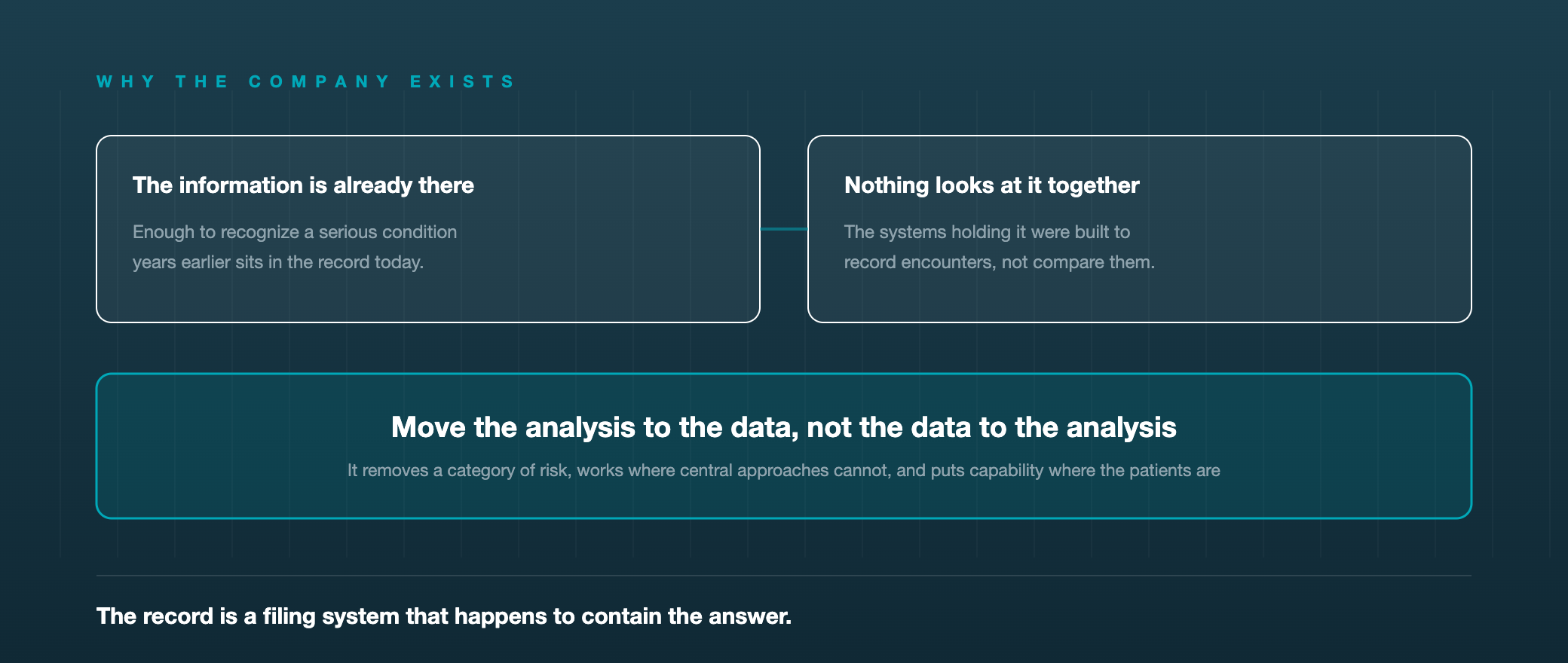
Two things are simultaneously true of modern healthcare, and the tension between them is the reason this company exists. The information required to recognize a serious condition years earlier than it is typically recognized is, in the majority of cases, already present in the patient’s record. And the systems holding that information are structurally incapable of considering it together, because they were built to record encounters rather than to compare them. The record is a filing system that happens to contain the answer.
Most attempts to address this have involved moving patient data somewhere it can be analyzed centrally. That route is closing, from three directions at once. Data protection regulation in a growing list of jurisdictions. Institutional policy that hardened after the last decade of breaches. And hospital boards who will not accept the residual risk of a transfer they cannot supervise, which is a reasonable position to hold. The organizations most willing to share data are rarely the ones holding the patients who need this work.
Reltronic was founded on the position that the analysis should move to the data instead. Not as a compromise. It is the better architecture. It removes an entire category of risk, it works in jurisdictions where central approaches cannot operate at all, and it puts capability in community and rural settings that would otherwise never get it.
Platform, not product
The platform is bounded rather than probabilistic. It cannot return a result the body could not produce, and the same record returns the same result every time. That is a design commitment, not a tuning choice, and it is why a clinician can interrogate a finding rather than take it on trust.
NeuSymbol is infrastructure. It is installed once inside an institution and extended over time as needs develop, across a portfolio of solutions that share the same foundation.
That structure matters to the institutions Reltronic serves. It means a hospital does not repeat an infrastructure decision each time it wants to address a new clinical question, and it means the capability available at a rural site is the same capability available at an academic center.
Principles
Reltronic does not hold patient data
Not as a policy that could change, but as a property of how the platform is built. We hold no patient records, and there is no configuration in which we would.
NeuSymbol does not replace judgment
The platform advises. Licensed professionals decide. We have declined work that would have required us to blur that line.
Reltronic publishes what it can defend
Performance claims are shared with methodology attached, under appropriate agreement, to people qualified to evaluate them. We do not publish numbers we cannot show the working for.
How Reltronic is structured
Reltronic, Inc. is a private Delaware corporation. It owns its intellectual property outright, including its patent portfolio, its software and its commercial rights.
Reltronic works with academic medical centers, research organizations, patient foundations and advocacy groups. Those organizations set their own research agendas and retain ownership of their own data. Reltronic supplies the infrastructure and the software.