
What this actually involves
An honest account of the work, the sequence, and what Reltronic requires from the institution.
The platform is bounded by physiology. It cannot produce a result the body could not produce, because that limit is built into the mathematics rather than applied as a filter afterward. It does not invent.
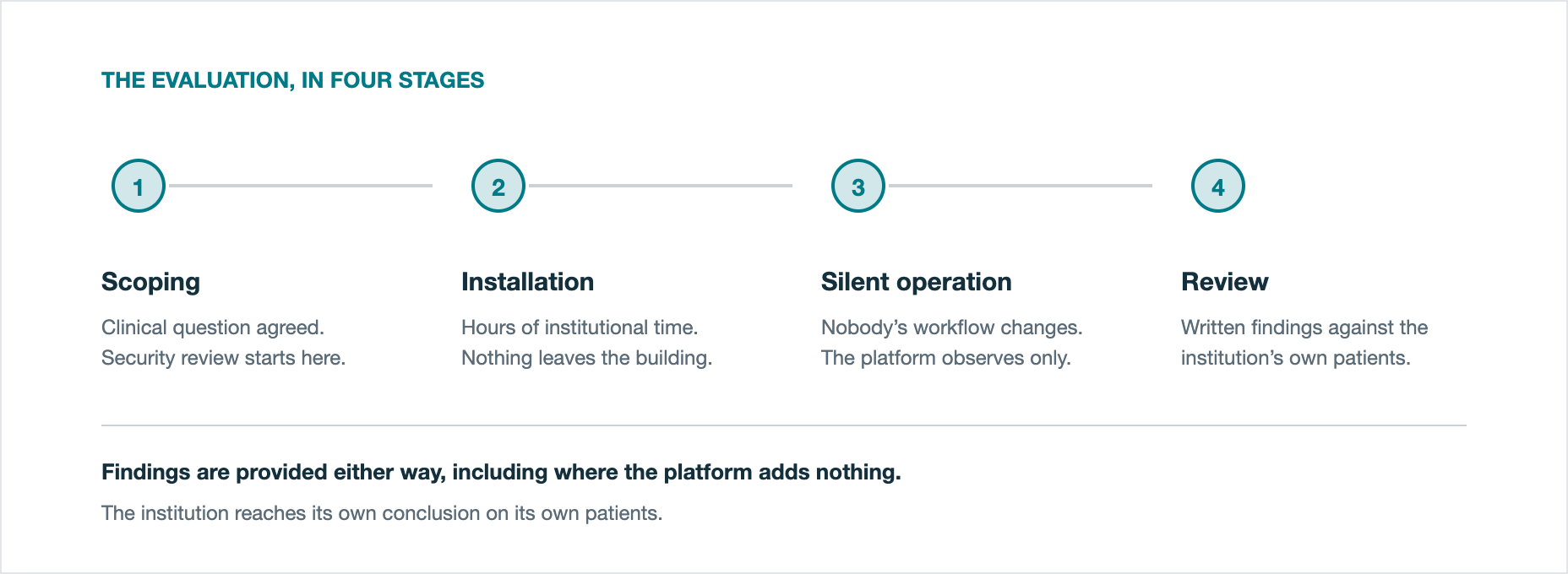
The evaluation, in four stages
Each stage ends when its exit condition is met rather than on a fixed calendar. An institution able to move quickly is not held to a schedule, and one whose data access takes longer is not pressed through a gate it has not cleared. The sequence is fixed. The duration is not.
Stage 1 · Scoping
Agreement on the clinical question, the data in scope and the measures of success. Security review begins here rather than at the end. The security team receives the full documentation package at this point.
Stage 2 · Installation
The system is delivered and installed in the institution’s data center. Read access is configured to the sources in scope. Reltronic performs provisioning and hardening. Typical effort required from the team is measured in hours, not weeks.
Stage 3 · Silent operation
The system runs against historical and current data without surfacing anything to clinicians. Sensitivity is tuned with clinical leadership using its own population. Nobody’s workflow changes during this period.
Stage 4 · Review
Written findings are presented to clinical and executive leadership. Where the institution proceeds, findings begin surfacing in workflow at the thresholds clinicians set. Where it does not, the analysis remains the institution’s and Reltronic removes the equipment.
Physical
Standard rack space, power and cooling in an existing data center or secure equipment room. Environmental requirements are provided during scoping and are modest.
Data access
Read access to the clinical sources in scope. No changes to existing systems, no schema modification, no migration, and no new documentation requirements for clinical staff.
People
A clinical sponsor, a technical contact and a security reviewer. Total time commitment during the evaluation period is typically a small number of hours per week.
It appears where clinical teams already work
Findings surface inside the record system clinicians already use, through standard health information exchange interfaces supported by major electronic record vendors. There is no separate application to open, no additional credential to hold, and nothing new to remember.
This is deliberate. Clinical decision support delivered in a separate system is not used, regardless of quality. The integration matters as much as the analysis.
Where an institution prefers findings delivered to a specific team rather than into general workflow, a rare disease service, a pharmacy group, a research office, that is supported and is frequently the better starting point.
Managed by Reltronic
Maintenance, capability updates and hardware replacement are Reltronic’s responsibility for the term of the agreement. Refresh is included in the arrangement agreed at the outset.
Support access is yours to grant
Support is exercised only at the institution’s invitation. Access is opened for a defined purpose, expires automatically, and is written to a log the institution’s own staff can read.
Ending cleanly
If an agreement ends, Reltronic coordinates removal of the equipment and provides written certification that all resident data has been destroyed.
What the equipment does with a record
The record system is not asked to change. Structured records arrive over the same health information exchange interfaces other clinical systems already use, and are read into a buffer rather than queried directly, so that a historical backfill of several years does not lock tables clinicians are actively using. This matters more than it sounds. Most integration projects fail on the day someone runs a large extract during clinic hours.
Free-text notes are handled on the appliance itself. They are not sent anywhere for interpretation. Terms extracted from narrative are checked against physiological limits before they are allowed into the patient’s profile, so a transcription artifact or a mis-keyed value does not silently become a clinical finding.
What happens between one patient and the next
Working memory and local caches are cleared between individual patient evaluations, inside a window of under twenty milliseconds. Nothing from one patient’s evaluation is present when the next begins. This is a design property rather than a policy, which is the distinction the security team will care about, because a policy can be misconfigured and a design property cannot.
What happens if someone opens the enclosure
The processing partition is physically separate and carries its own power, so it remains protected when the unit is unplugged. If tamper sensors register that the enclosure has been opened, the encryption keys held on the unit are destroyed. Resident data becomes mathematically unrecoverable rather than merely inaccessible.
A stolen appliance is therefore not a breach of patient data. For most institutions this is a shorter conversation with their privacy office than any cloud arrangement can offer, because there is no transfer to assess and no processor to add to a register.
What auditors are given
Every transformation of clinical data, from the moment it is read to the moment a finding is presented, is recorded inside the secure boundary of the appliance. Each step is timestamped and signed with a cryptographic hash. The record is held in non-volatile memory, so it survives power loss and can be reconstructed afterward.
The practical consequence is that when someone asks why the system surfaced a particular consideration for a particular patient eighteen months ago, that question has an answer, and the answer can be shown rather than asserted. Institutions running the platform for research use these records to demonstrate data integrity against the standards regulators expect of clinical evidence.
What Reltronic cannot do, by construction
Reltronic holds no standing access to the institutional environment. There is no always-on tunnel, no vendor account waiting in the institution’s directory, and no scheduled outbound job. Support access is opened by the institution, scoped to a defined purpose, time-limited, and logged where the team can read it. When the window closes, the access does not persist.
There is also no configuration in which patient information leaves the equipment. Not an optional one, not a disabled one, not one behind a support flag. The system telemetry that does leave carries operational information about the appliance and contains no clinical content.