
The community already gave the organization the data
Patient foundations and disease registries hold something no sponsor and no health system can assemble independently: years of longitudinal information on a small population, contributed by families who were told it would help find a treatment. That contribution is frequently not in a form a regulator will accept, and the gap between a registry that exists and evidence that can support a submission is where a great many rare disease programs quietly stall. NeuSymbol closes that gap without the organization relinquishing custody of anything.
Why registries stall
Most rare disease registries are built the only way they can be: survey instruments, manual entry, families reporting from memory, tools that were never designed to link to medical records. The result is a dataset containing genuine clinical signal mixed inseparably with transcription errors, recall gaps and inconsistent definitions.
Conventional analysis cannot separate the two. A misplaced decimal and a real physiological anomaly are statistically indistinguishable. And so the dataset, representing years of effort and considerable trust, is judged unusable for regulatory purposes, and a sponsor declines to build a program on it.
This is among the most common and least discussed reasons rare disease programs fail to advance. The data was collected in good faith, over many years, by people with limited resources and no expectation that a regulator would one day examine its provenance. By the time a sponsor is interested, the questions being asked about definitions, collection instruments and inter-rater consistency cannot be answered retrospectively.
Validated against biology
Recorded values that describe a physiological state the human body cannot occupy are identified as errors rather than treated as outliers. That distinction is what makes a defensible inclusion and exclusion record possible.
Structured to a standard
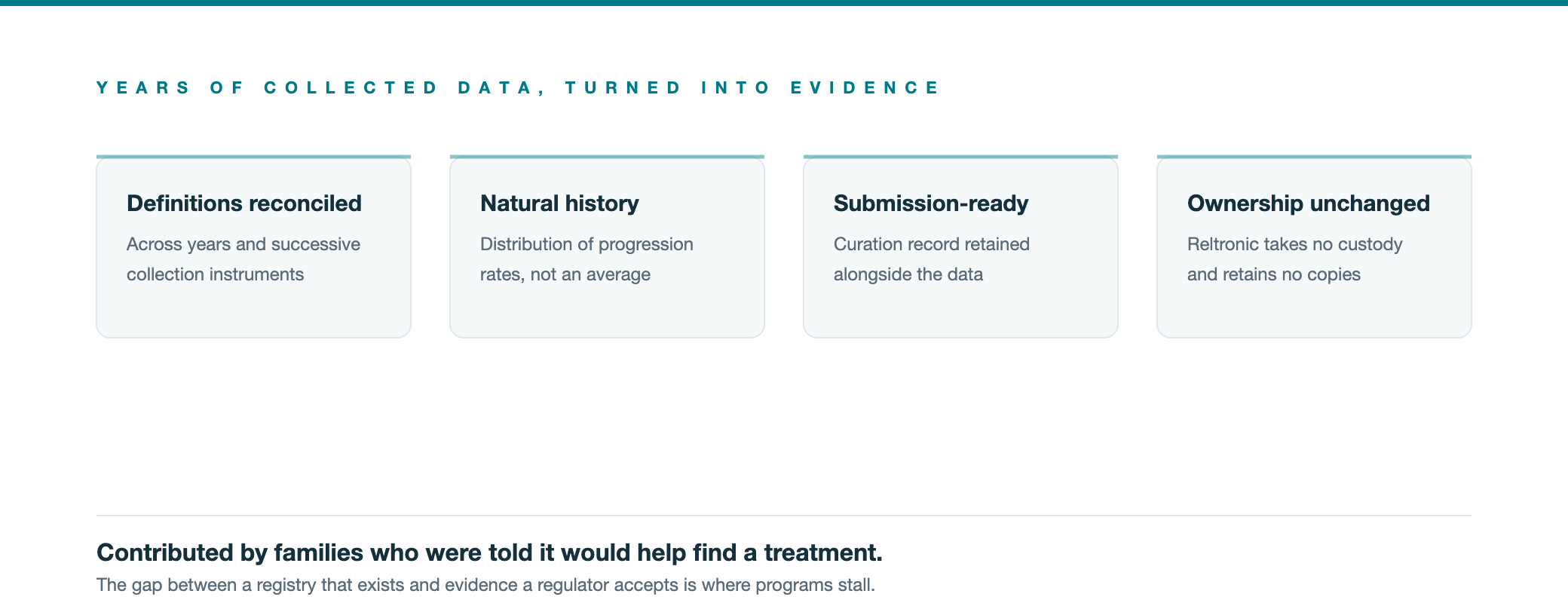
Inconsistent definitions and formats accumulated across years and successive collection instruments are resolved into a consistent structure, with every mapping decision documented rather than applied silently. A reviewer can therefore see not only the final dataset but the reasoning that produced it, which is the difference between a dataset that is usable and one that is merely available.
Progression, not snapshots
Reading the direction and rate of change across a registry population produces a documented natural history, including the distribution of progression rates across the cohort rather than a single average. That distribution is what a sponsor requires to size a trial, select an endpoint and set a realistic follow-up period, and its absence is a common reason a program stalls before a protocol is written.
The data remains with the organization
The organization retains sole ownership of the underlying data contributed by the community. That is not a courtesy; it is the contractual basis on which Reltronic works, and Reltronic will not vary it.
Processing takes place within the organization’s own environment. Reltronic does not take custody of the registry, does not retain copies, and has no means of accessing it outside the terms the organization sets and can withdraw. For an organization holding data contributed by families on the understanding that it would be protected, this is generally the first question asked and the one on which the conversation turns.
Commercial arrangements concerning the use of validated outputs are defined explicitly in writing before any work begins, in language the organization’s board and the organization’s families can read. Foundations should expect and insist on that clarity from any technology partner. If a proposed arrangement cannot be explained plainly to the people who contributed the data, it is the wrong arrangement.
What validated evidence unlocks
A registry that meets regulatory standards changes what a foundation can do. It supports natural history evidence for regulatory discussions. It allows comparison groups to be constructed so that fewer children have to receive a placebo. It gives a sponsor evaluating whether to pursue a program an answer instead of an unknown.
It means the contribution families made counts for something concrete.