
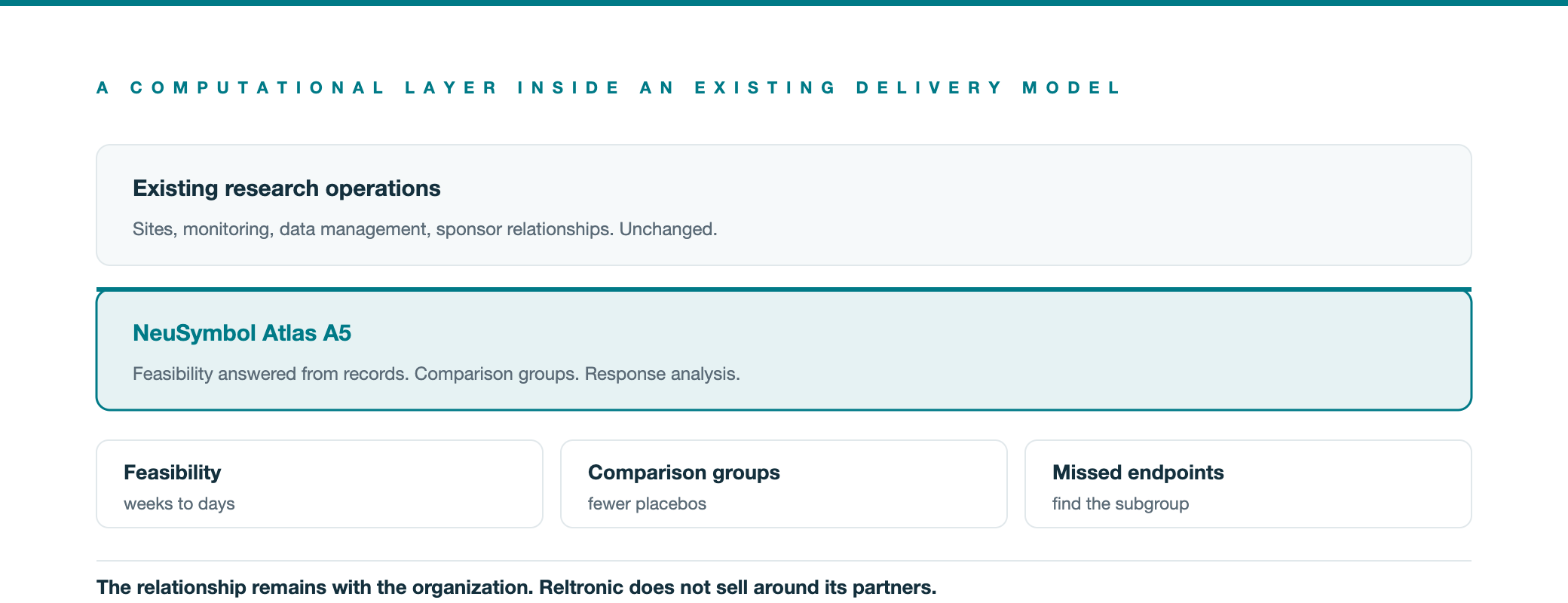
A computational layer inside an existing delivery model
NeuSymbol is deployed alongside existing research operations rather than in place of them. It cuts the manual effort in feasibility and cohort work. It also gives you something most contract research organizations cannot offer a sponsor: analysis run inside the participating institutions, with no site required to release patient records to take part. For an organization competing on delivery speed and site network quality, that is a difference in what can be promised at bid stage rather than a difference in tooling.
Where it fits
Feasibility and cohort identification
Establishing whether a protocol is feasible across a network is slow, largely manual, and frequently wrong in a predictable direction. Site estimates of eligible patient volume are optimistic because they are made by people who want the study, and the correction arrives months later as enrollment shortfall. Run the question across participating sites without moving any data and a multi-week exercise becomes a short one. The answer reflects what the records actually contain, not what coordinators believe they contain.
Comparison groups
Sponsors increasingly need control arms that do not randomize patients to placebo. That is sharpest in pediatric and rapidly progressive conditions, where a placebo arm is hard to defend and the eligible population is too small to divide. The ability to construct such groups from real-world data, and to document their derivation to the standard a regulator will accept, is a capability few organizations can offer today and one that is increasingly decisive in competitive bids.
When an endpoint is missed
A trial that fails on its primary endpoint frequently still contains a subgroup that responded. Separating the course of the condition from the effect of treatment can identify that subgroup, and with it a defined indication rather than a terminated program.
Automating the work that slows delivery
A substantial share of real-world evidence budgets is consumed by manual effort, chart abstraction, review, reconciliation. That work is expensive to staff, hard to scale, and difficult to price at an attractive margin.
The platform automates a meaningful portion of it, executing inside the institution where the records already are. For an organization delivering these services, that converts a labor-constrained line of business into one that scales, and it makes capability available that is currently offered by very few competitors.
Reltronic does not sell to sponsors around Reltronic’s research partners. Where an organization brings the relationship, the relationship remains theirs.
Deployment model
Deployment is through NeuSymbol Atlas, installed within participating sites or within its own environment under the institution’s governance. Reltronic handles provisioning, installation and support.
No patient data is transferred to Reltronic at any point, and none is transferred between sites. This is frequently what makes multi-site work possible at institutions that would otherwise decline to participate.