
Evidence from where the patients actually are
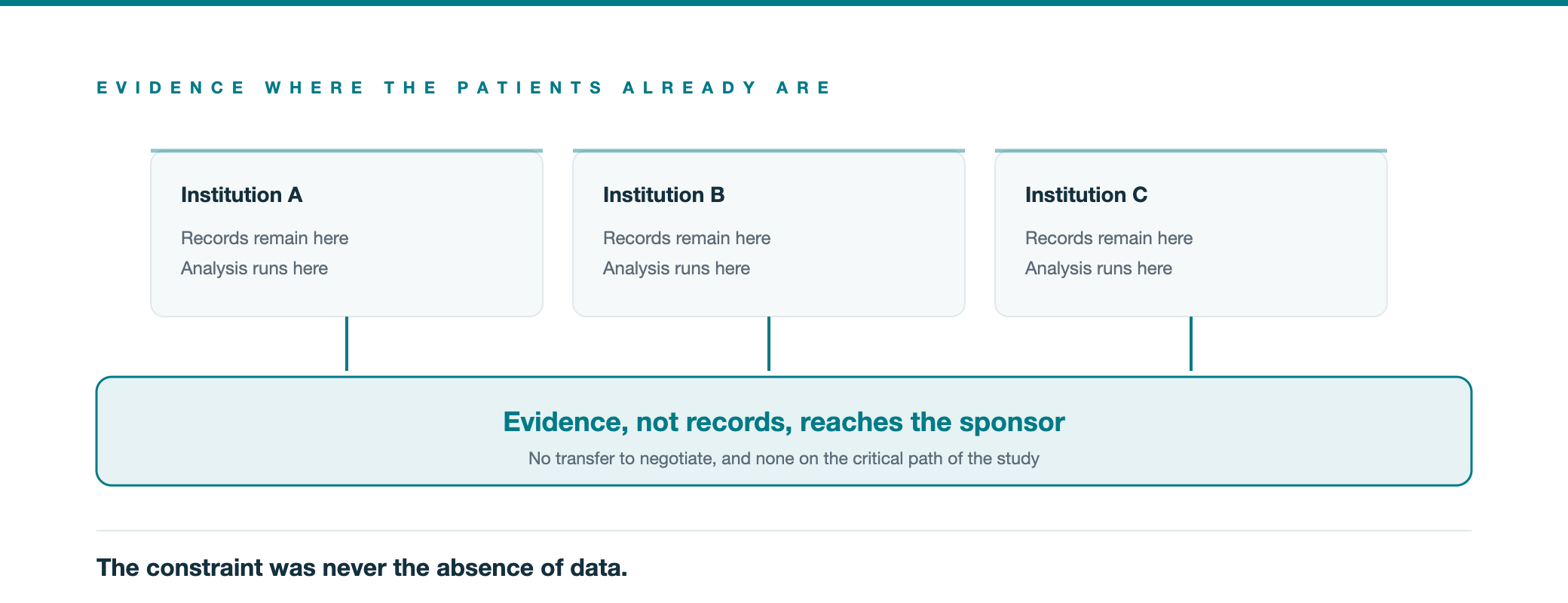
The constraint on real-world evidence has never been the absence of data. It is that the data sits inside institutions which cannot release it, and the governance work required to move it consumes more of a development timeline than the analysis it enables. NeuSymbol operates inside those institutions instead. Comparison cohorts and real-world evidence are generated where the records already reside, and what reaches the sponsor is the evidence rather than the records, which removes the transfer question from the critical path entirely.
The platform is bounded by physiology. It cannot produce a result the body could not produce, because that limit is built into the mathematics rather than applied as a filter afterward. It does not invent.
Where sponsors apply the platform
Comparison cohorts
Constructing a control group in a small or vulnerable population is both an ethical and a practical problem. In pediatric and rapidly progressive conditions, randomizing patients to placebo is increasingly difficult to justify, and there are frequently too few patients to randomize at all. The platform builds comparison cohorts from real-world data, held to what is biologically possible, and documented for regulatory review.
Understanding who responds
An asset that appears to fail across a whole population may be working well in a subgroup. The platform separates the course of the disease from the effect of the drug. That shows which patients benefited and why the others did not. It is often the difference between a terminated program and a defined indication.
Reaching eligible patients
The large majority of patients with rare conditions are not at specialist centers and are not reachable by conventional recruitment. Because the platform operates where those patients actually receive care, eligible individuals can be identified in community settings and referred through their own clinicians.
Natural history
Some conditions have no established progression model. Reading trajectory across an existing population builds one, with a documented distribution of progression rates. That evidence supports endpoint selection and trial design before the first patient is enrolled.
The objection this was built to answer
The standing objection to synthetic and simulated clinical evidence is straightforward and correct: a generative system will produce outcomes that are statistically plausible and biologically impossible. One such record in a submission dataset does not reduce the dataset’s quality. It ends its usefulness.
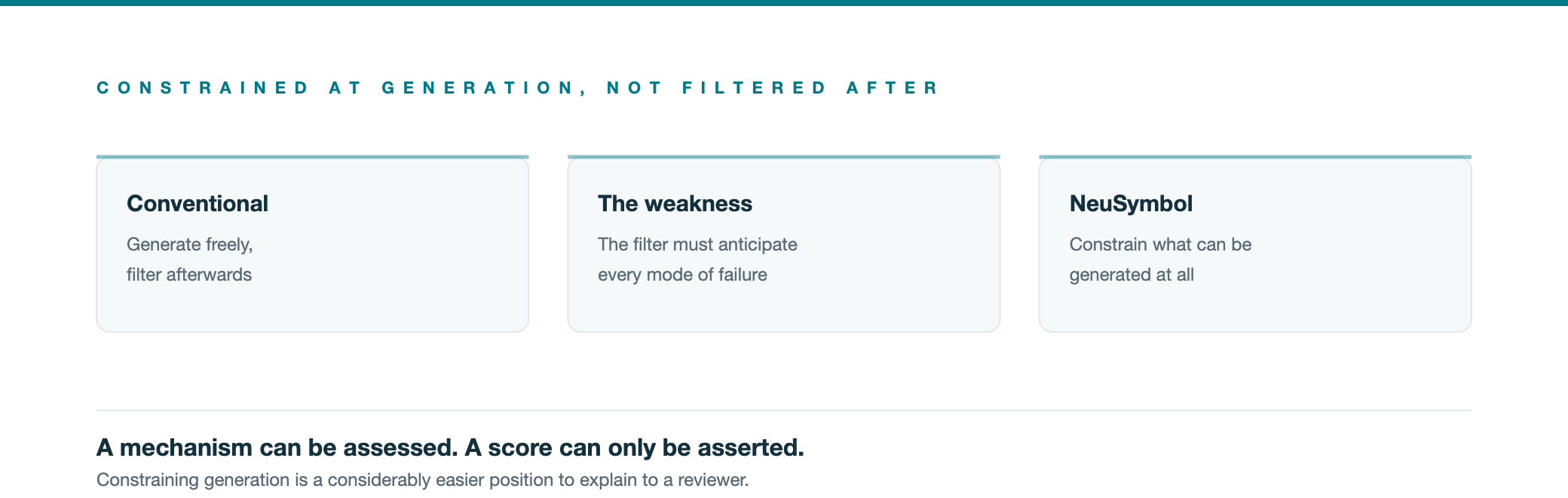
The conventional mitigation is to generate freely and filter afterwards. That approach is only as good as the filter’s ability to anticipate every mode of failure, and it leaves the sponsor carrying the burden of proof at review, defending outputs whose generation was unconstrained. Constraining generation is a materially stronger position than filtering after the fact, and it is a considerably easier one to explain to a reviewer.
Reltronic’s approach is different. The platform is constrained so that a physiologically impossible outcome is not something it produces and then rejects, it is something it cannot produce. That constraint is a property of how the system works, not a check applied at the end.
The practical consequence for a sponsor is that the conversation with a reviewer concerns a documented mechanism rather than a model’s performance metric. Mechanistic arguments are assessable. A score is asserted, and a reviewer who cannot interrogate how it was produced has little option but to discount it.
Documented from source
Complete record
Every step from source data to final output is logged the moment it happens, in a record that cannot be altered without trace. The structure follows the standards regulators apply to clinical evidence: attributable, legible, contemporaneous, original, accurate. The record is generated as a by-product of the work rather than assembled afterwards for submission, which is the distinction that tends to matter when an inspector asks how a given figure was derived.
Verified at the source
Data is validated at the point of entry, inside the institution that holds it, rather than reconstructed after extraction and transfer. Extraction is where provenance is most commonly lost, and where the questions that cannot be answered later tend to originate.
Independently checkable
The biological constraints applied are drawn from published, peer-reviewed science rather than from anything proprietary. A reviewer is therefore able to assess whether they were applied correctly, and whether they were the right constraints, without access to proprietary internals.
Standards work
Reltronic participates in international work on evidentiary standards for computational and simulated clinical evidence, and the platform is developed in alignment with the direction of European and United States regulatory thinking on real-world and in-silico evidence.
Reltronic takes the position that a sponsor should not be the first party to test whether an evidence-generation method is acceptable. Engagement with standards bodies ahead of submission is part of how the platform is built.
Participation in standards work does not constitute endorsement of Reltronic or its technology by any regulatory authority.
How sponsors engage
Engagements typically begin with a defined feasibility assessment against an existing question, a program where recruitment has stalled, an endpoint that is difficult to establish, or a population too small for a conventional control arm.
Deployment is through NeuSymbol Atlas, configured for evidence generation and installed within the data holder’s own environment under their governance. Sponsors receive evidence and analysis. They do not receive, and do not need, anyone’s patient records.