
The expertise, without the transfer
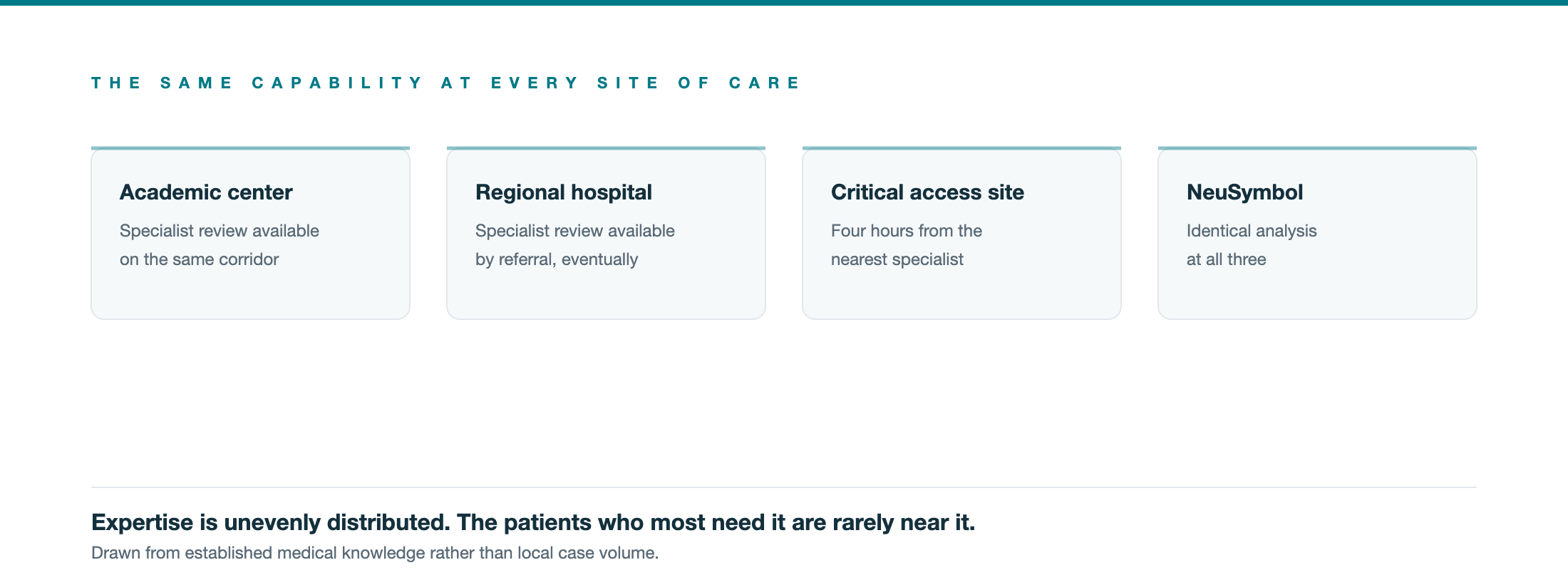
The difficulty for a multi-site system is not that expertise is absent. It is that expertise is unevenly distributed, and the patients least likely to be near it are frequently the ones who most need it. NeuSymbol places the same interpretive capability at every site in the system, drawn from established medical knowledge rather than from local case volume, running on equipment the institution hosts and reading records that never leave its network. A patient presenting at a critical access site receives the same analysis as one presenting at the flagship academic center.
The platform is bounded by physiology. It cannot produce a result the body could not produce, because that limit is built into the mathematics rather than applied as a filter afterward. It does not invent.
What it addresses
Patients who are already yours
Every system carries patients who have been seen repeatedly without resolution. Their records contain the pattern; nothing in the building compares those encounters to one another. The platform does, and surfaces them for review.
Therapy that is not working
High-cost therapies help some patients considerably and others not at all, and there is rarely a practical way to tell which is which. The platform identifies patients whose response indicates the therapy is not benefiting them, so they can be moved to something that will.
Deterioration before the event
Patients moving toward an acute episode frequently look acceptable at each individual encounter. Reading direction and speed of change surfaces them earlier, when intervention is still possible and considerably less costly.
The financial case, stated plainly
Two effects account for most of the financial case, and both are measurable against the institution’s own historical data before any commitment is made.
Therapy matched to response. Continuing a high-cost therapy in a patient who is not benefiting is expenditure without clinical return, and it delays the alternative that might work. Identifying those patients converts spend into either better outcomes or genuine savings, and either result is defensible to the institution’s board and to clinicians.
Acute episodes avoided. A single prevented crisis admission in a complex patient represents a substantial avoided cost, and a materially better outcome for that patient. Earlier recognition is where that value is created.
Reltronic does not publish generalized savings figures, because they would be guesses about the institution’s population. What Reltronic does is quantify both effects against its own historical data during evaluation, and provides the analysis regardless of whether the institution proceeds.
It has to work in clinical practice
Clinical decision support fails at adoption far more often than at accuracy. Systems that add clicks, generate frequent low-value alerts, or appear to second-guess judgment get switched off, formally or informally, within a quarter.
The platform surfaces findings inside the record clinical teams already use. There is no separate application, no additional login, and no new documentation requirement. Sensitivity is tuned with clinical leadership during evaluation rather than shipped as a default, and every finding can be dismissed without justification.
The platform advises. Clinicians decide. That boundary is absolute and is not exposed as a configuration option to any customer, at any tier, under any commercial arrangement.
The review is smaller than the institution expects
There is no cloud service to assess. No third-party processor to add to the register. No cross-border transfer to justify. No egress to monitor or defend at audit. For most systems this converts a nine to eighteen month procurement into an equipment review of the kind conducted routinely for clinical hardware.
The equipment sits in the institution’s data center alongside the other clinical systems that already process patient information on-premise, under institutional access controls, with keys in the institution’s custody. It operates in a fully isolated configuration where the institution’s policy requires it.
Every site, not only the flagship
Capability does not differ across the family. A twenty-five bed rural hospital runs the same clinical platform as a thousand-bed academic center, sized to its population and its retained history rather than restricted in what it is permitted to evaluate.
NeuSymbol Meridian
Multi-hospital systems and academic medical centers, serving affiliated sites from a central deployment.
NeuSymbol Vantage
Independent community and regional hospitals. Full capability without a dedicated research computing function.
NeuSymbol Beacon
Critical access hospitals, rural clinics and ambulatory sites, the settings where a specialist is furthest away.
Begin with an evaluation
Institutions typically begin with a defined evaluation against their own historical data. Equipment, installation and support across the evaluation period are provided by Reltronic.
The institution receives a written analysis of what was found: patients whose records indicate an unresolved condition warranting review, patients whose therapy appears not to be benefiting them, and the measured effect on its own population. That analysis is yours regardless of whether the institution proceeds.
Questions clinical leadership asks first
How does this differ from decision support already running in the record system?
Conventional decision support evaluates a result against a threshold at the moment it is recorded. It is built to be reliable in the common case, which is the correct design objective for the majority of patients and the reason it performs poorly for the minority who present atypically. NeuSymbol evaluates the relationship between encounters rather than the value within one. A patient whose results have each remained inside the reference interval for two years, while moving consistently in one direction, is invisible to a threshold and visible to a trajectory. The two approaches are complementary, and NeuSymbol is not a replacement for the alerting already in place.
Will this add to alert fatigue?
Alert fatigue is a patient safety problem, not an inconvenience, and it is the most common reason clinical decision support is switched off within eighteen months of purchase. NeuSymbol is configured to surface rarely and specifically. Findings appear passively within the record when a clinician opens it, rather than as an interruption, a page or a dashboard alarm. Sensitivity is set with your clinical leadership during the evaluation, not shipped as a vendor default. If the volume feels excessive, the configuration has failed. That is our conclusion to draw, not your staff’s tolerance to question.
Where does liability sit?
The platform advises. The licensed clinician decides. NeuSymbol takes no autonomous action, issues no order, and creates no duty that did not already exist. Every finding carries the observations underneath it, so the clinician reaches an independent view instead of deferring to the output. Institutions typically address the documentation of dismissed findings in local policy, and Reltronic works through that language with risk management before go-live rather than after an incident. No vendor can insulate an institution from clinical liability, and any that claims otherwise should be asked to put it in the contract.
Does patient data leave the hospital?
No, and this is a property of where the software runs rather than a policy that could later be revised. The platform is installed on equipment in the institution’s own server room and operates on records inside the institutional network, in the same manner as the imaging reconstruction and laboratory systems already processing identifiable data on the premises. Network communication is outbound only, requiring no inbound firewall exception. Where policy requires it, the platform runs with no external connectivity whatsoever.
What does this require from the IT organization?
Rack space, power, and read access to the clinical sources in scope. There is no schema change, no data migration, and no new documentation requirement for clinical staff. Findings surface through the interfaces the record system already exposes, which for most institutions means the advisory mechanism their clinicians already recognize rather than a new application with a new credential. Typical effort from institutional staff during installation is measured in hours.
How can an institution establish that it works in its own population?
By running it against the institution’s own historical records before it influences any clinical decision. During the evaluation period the platform operates silently, generating findings that are reviewed retrospectively against known outcomes. The institution therefore assesses performance on its own patients, at its own sites, before anything is surfaced to a clinician. Published performance figures from other institutions are of limited value in this population and are not offered as a substitute.
What happens when it is wrong?
It will sometimes be wrong, as will any system operating on incomplete clinical data. That is precisely why the output is a reviewable trajectory with its supporting observations attached rather than an opaque score. A clinician can identify a spurious finding in seconds and set it aside with or without a reason. Dismissals inform local tuning. Transparent imperfection is a considerably safer property in clinical software than confident opacity.
What is the regulatory status?
NeuSymbol has not been cleared or approved by the U.S. Food and Drug Administration. It is intended to support, and not to replace, the judgment of qualified health care professionals. Reltronic maintains a written classification assessment of each software function against the criteria at section 520(o)(1)(E) of the Federal Food, Drug, and Cosmetic Act, and provides it to evaluating institutions on request under non-disclosure. Institutions whose regulatory affairs function wishes to review that assessment before the commercial conversation are encouraged to ask for it early.
How does an evaluation begin?
Commercial terms are discussed directly with the institution. The evaluation is designed to proceed on clinical judgment, and to produce a written result an institution can weigh on its own terms. The analysis of the institution’s own population is delivered at the end of the period and is retained by the institution whether or not it elects to continue.