
Reconciliation, not second-guessing
Every entry in a record was made by a clinician doing their best with what was in front of them at that visit. Nothing in this platform revisits that. What it does is reconcile two accounts of the same patient that are ordinarily read separately: what the record states across encounters, and how the patient’s biology has been behaving over the same period.
Where the two agree, nothing is surfaced. Where they diverge, the divergence is presented with every contributing result attached, so the reasoning can be examined rather than accepted. The platform does not state what the divergence means. That judgment belongs to the clinician, who has the patient in front of them and the platform does not.
Someone noticed. Now it can be proven.
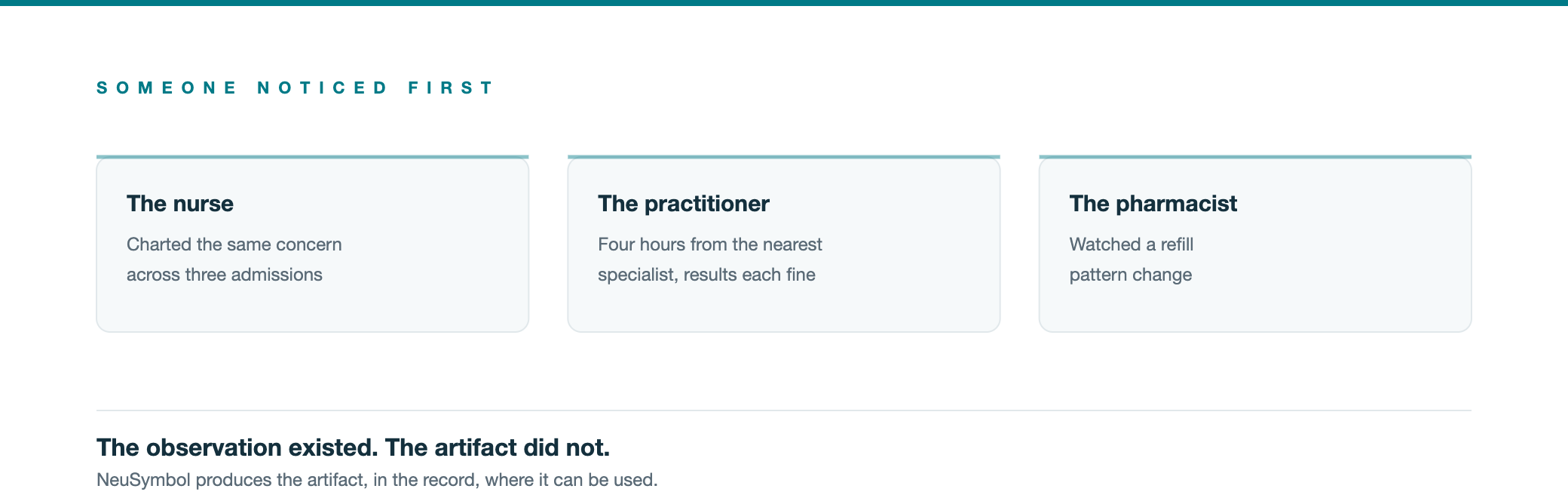
In most delayed diagnoses somebody saw it first. A nurse charts the same concern across three admissions, a nurse practitioner four hours from the nearest specialist holds a set of results that are each individually unremarkable, a pharmacist notices a refill pattern change. The observation exists. What is missing is the artifact: something that converts a clinical instinct into a documented reason to act, in a form that survives a referral conversation. NeuSymbol produces that artifact by reading a patient’s encounters as a sequence and presenting the trajectory, with every contributing observation attached, inside the record where the decision is being made.
The patients are the rare, the complex, the high-avidity and the non-responders: the ones who have already survived several rounds of evaluation without an answer. Findings are deterministic, so the same record gives the same result every time, and the differential it broadens is always shown with the evidence beneath it.
The chart that reads fine and the child who is not
A four-year-old has been seen eleven times in three years. Recurrent vomiting, poor stamina, intermittent muscle pain. Every panel comes back within reference range. Each visit is closed reasonably: viral illness, growing pains, reassurance and follow-up as needed.
The nurse who has now seen him four times has written some version of “mother reports he tires much faster than his siblings” three separate times. She has said out loud, more than once, that something about this child is not right. She is correct, and she has no mechanism to make that correctness actionable.
Nothing in the record computes across those eleven visits. There is no view that puts them in sequence. The values are individually normal and collectively alarming, and no system in the building is looking at them collectively.
He will present in metabolic crisis at some point in the next two years, and the diagnosis will be made in an intensive care unit, after irreversible injury, by a team seeing him for the first time.
This is the specific failure NeuSymbol exists to interrupt. Not a failure of clinical skill. A failure of instrumentation.
What it puts in front of the clinician
A trajectory, not a score
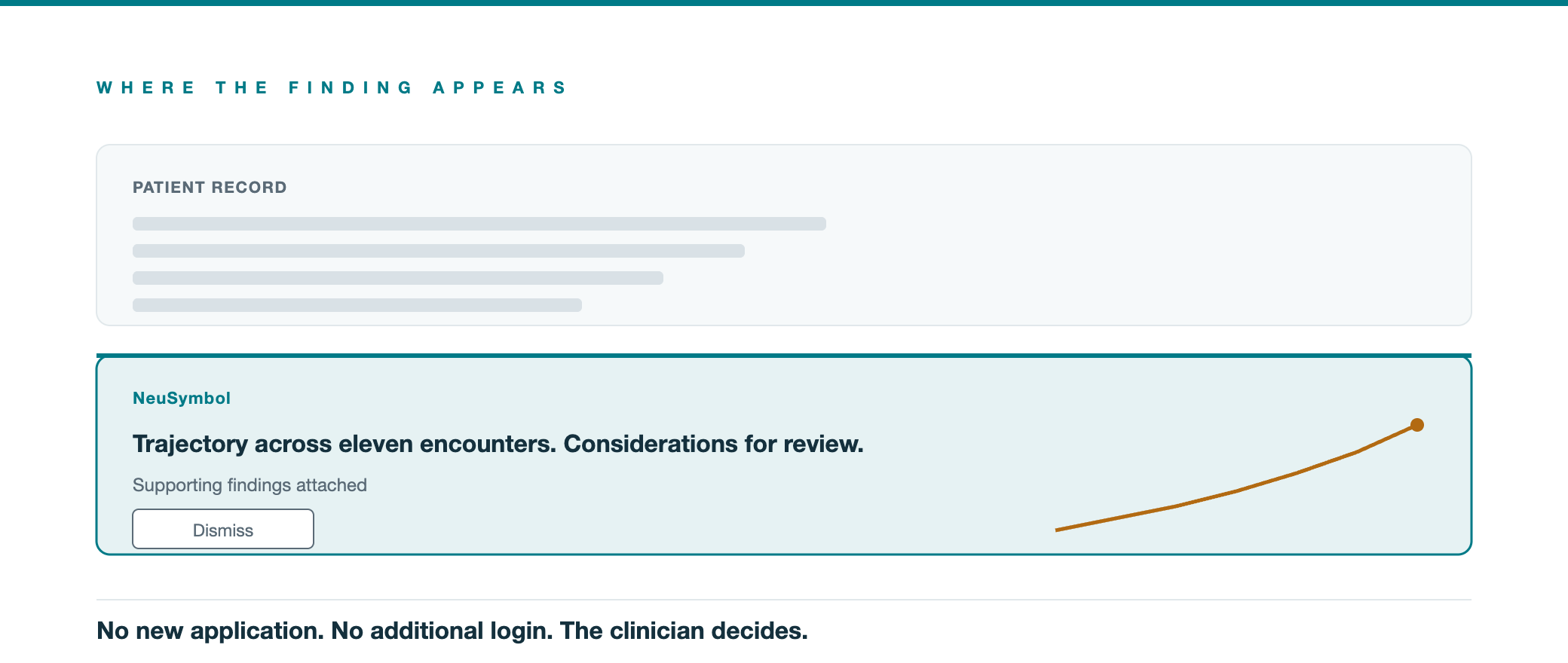
The output is a progression curve across the patient’s own prior encounters, with the contributing observations attached. The clinician sees what the system saw and judges it independently. No figure is presented that has to be taken on faith.
The reasoning, in clinical terms
Every finding carries its rationale: which observations, across which encounters, mapped to which recognized presentation. Where a clinician disagrees with the reasoning, the precise point of disagreement is visible.
A defensible reason to escalate
A documented trajectory can go into a referral, to an attending, or to a family. It converts an instinct about a patient into a clinical artifact, which is the difference between a concern being dismissed and being acted on.
For the people who see the patient most
Nurses are usually the first to know that something is changing, and are structurally the least equipped to make that knowledge move. Longitudinal observation is nursing’s native skill and the one the record is worst at capturing. The most important information about a deteriorating patient is frequently in a nursing note that nothing will ever compute over.
NeuSymbol reads those narratives. Nursing documentation is a first-class input to the reasoning engine, not an afterthought behind structured lab values.
For nurse practitioners and physician assistants, particularly in community, rural and federally qualified settings, the problem is different and harder. They are frequently the entire diagnostic capability available to the patient. There is no metabolic geneticist down the hall to curbside. A referral that cannot be justified is a referral that does not happen.
The system was designed for exactly that position. It applies established medical knowledge rather than depending on how many similar cases a clinic has seen, so it performs at sites with no prior experience of a condition. It does not require local precedent. It brings the precedent with it.
Nursing narrative is an input
Free-text observation is read and mapped to standard clinical terminology alongside structured results.
Useful where there is no specialist
Because it applies established medical knowledge, the system performs at sites with no prior cases of a condition.
Referral support, not referral replacement
Output is structured to accompany a referral and answer the receiving specialist’s first question.
What Reltronic commits to
No additional clicks
Nothing to open. No second application, no second password. Output surfaces through SMART on FHIR inside the record already in use.
Quiet by design
Alert fatigue is a patient safety hazard. The system is tuned to surface rarely and specifically. Sensitivity thresholds are configured with clinical leadership rather than imposed by the vendor.
It can always be dismissed
Every finding can be dismissed, with or without a reason. Dismissals inform local tuning. No clinician is blocked, forced, or made to justify overriding the system.
It never decides
NeuSymbol does not diagnose, prescribe, order, or act. It has no authority. Clinical judgment remains entirely with the licensed professional at the bedside.
The questions clinicians actually ask
Q: Is this going to increase my liability?
The system produces decision support, not a diagnosis. It creates no duty that did not already exist, and it documents no finding as unacted upon unless it was shown and dismissed, which is the same standard as any other consultation. Institutions typically address documentation of dismissals in local policy, and Reltronic works with risk management on that language before go-live.
Q: How often will it interrupt me?
Configurable, and deliberately low. Tuning is done with clinical leadership during the evaluation period rather than shipped as a default sensitivity. If it is noisy, it has failed, and Reltronic treats that as a defect in the product rather than a tolerance problem in the clinic.
Q: What if it is wrong?
It will sometimes be wrong. Any system operating on incomplete clinical data will be. This is why the output is a reviewable trajectory with its supporting observations attached rather than an opaque score, so that a spurious finding can be identified quickly and set aside. Transparently imperfect is preferable to confidently opaque.
Q: Does it see my patients’ data? Does the company see it?
No. The system runs on equipment inside the institution. Reltronic personnel have no access to patients’ records, and no configuration exists in which patient information is transmitted to Reltronic.
Q: Is it going to be used to evaluate me?
That is an institutional policy question, not a technical one, and institutional leadership should answer it explicitly before deployment. Reltronic’s position is that the system exists to support care, and Reltronic will support a policy that limits its use accordingly.
Q: Do I have to change how I document?
No. It reads what clinicians already write.
Where it would get in the way
Reltronic would rather hear the objection during design than discover it during rollout. Clinical advisory conversations are scheduled directly with the Reltronic team.