
Four systems. One platform.
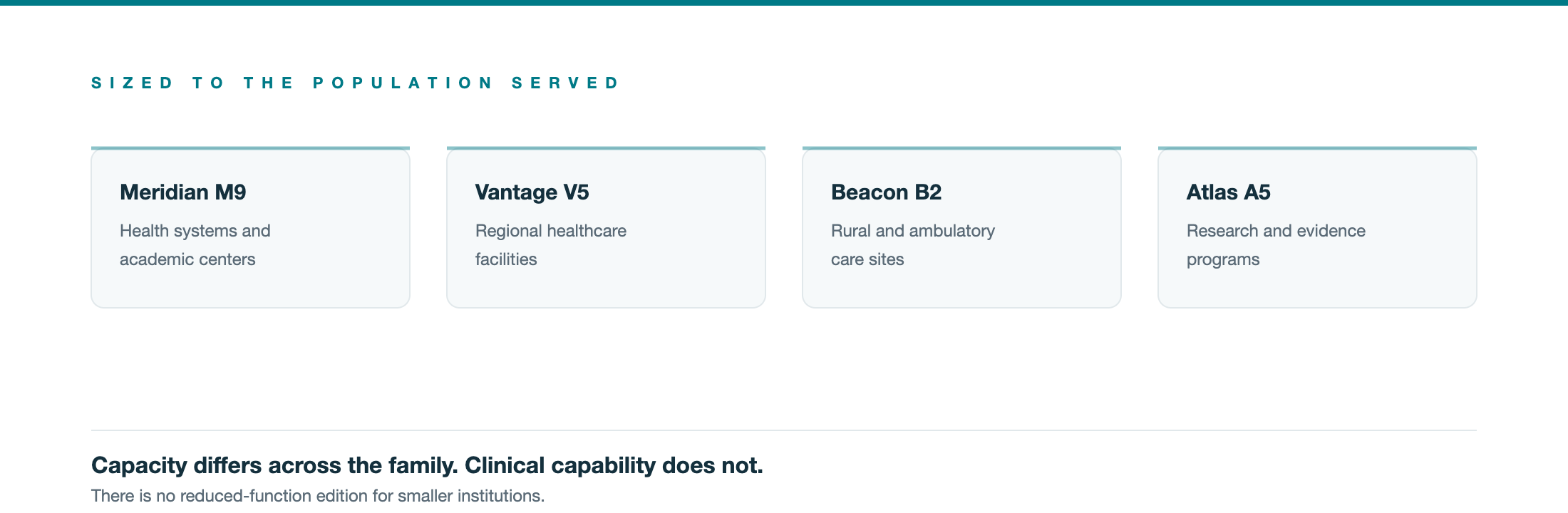
NeuSymbol is supplied in four configurations, distinguished by the volume of work each is built to carry rather than by what each is permitted to do. A critical access hospital and a large academic medical center run the same clinical capability on the same platform, sized to the population served and the history held. There is no reduced-function edition, and no capability is withheld from smaller institutions, because the patients who most need this work are distributed without regard to the size of the hospital they present at.
Where a patient is treated should not determine what can be seen
The clinical argument for this platform is that interpretive capability should not be concentrated in a small number of large institutions. That argument is only credible if the system deployed at a twenty-five bed hospital does the same clinical work as the one deployed at a thousand-bed academic center.
It does. The configurations differ in capacity alone: the number of sites served, the depth of clinical history held in working memory, and the number of solutions running concurrently. Clinical capability is identical across all four. A rural clinic evaluating a child with an undiagnosed metabolic presentation receives the same analysis, drawn on the same established medical knowledge, as an academic center evaluating the same child would.
The NeuSymbol system family
NeuSymbol Meridian
Health systems and academic medical centers
The reference configuration. Built for multi-hospital systems, academic medical centers and institutions running several solutions concurrently across large populations and long clinical histories. Supports research and care delivery on the same footprint, with the capacity to serve affiliated sites from a central deployment.
NeuSymbol Vantage
Regional and community hospitals
The core configuration for independent community hospitals and regional systems. Full clinical capability at the scale of a single hospital or a small group, sized for institutions without a dedicated research computing function, and designed to require none.
NeuSymbol Beacon
Critical access, rural and ambulatory sites
Built for the settings where specialist interpretation is furthest away and matters most: critical access hospitals, rural clinics, federally qualified health centers, specialty practices and ambulatory sites. Compact enough for a small equipment room, and capable of operating with no outbound connectivity at all. Because the platform applies established medical knowledge rather than relying on local case history, a site that has never seen a condition is still able to recognize it.
NeuSymbol Atlas
Sponsors, research organizations and registries
Configured for evidence generation rather than point-of-care delivery. Deployed with biopharmaceutical sponsors, clinical research organizations, patient registries and foundations to build comparison cohorts, validate collected data and support regulatory submission, within the data owner’s own environment, under their own governance.
Deployment fit
Capacity specifications, rack and environmental requirements, power and cooling figures, and integration prerequisites are provided in full during evaluation, before any commitment is made. Institutions with constrained equipment rooms should raise that early, because configuration is chosen around the physical space available rather than the other way round.
| Meridian | Vantage | Beacon | Atlas | |
|---|---|---|---|---|
| Typical setting | Multi-hospital system, academic medical center | Community or regional hospital | Critical access, rural clinic, ambulatory, specialty practice | Sponsor, research organization, registry, foundation |
| Sites served | Many | One to a few | One | Varies by program |
| Solutions running concurrently | Multiple | Multiple | Focused | Evidence and curation |
| Dedicated IT or research computing staff assumed | Yes | Not required | Not required | Varies |
| Fully isolated operation | Supported | Supported | Supported | Supported |
| Clinical capability | Full | Full | Full | Research configuration |
Refresh and support
Included in the arrangement
Systems are provided under a service agreement rather than sold as capital equipment. Reltronic handles procurement, provisioning, installation, maintenance and replacement. Institutions do not own, depreciate or dispose of the hardware.
Managed lifecycle
Capability improvements are delivered to installed systems throughout the agreement. Hardware refresh is Reltronic’s responsibility.
Scales without replacement
Institutions typically begin with one solution and add others against the same installed system. Moving between configurations as a network grows does not require starting over.
Solutions available across the family
NeuSymbol Detect
Surfaces patients whose presentation is consistent with rare or under-recognized conditions.
NeuSymbol Trajectory
Presents rate of change across encounters, with the contributing findings attached.
NeuSymbol Response
Distinguishes patients benefiting from high-cost therapy from those who are not.
NeuSymbol Evidence
Builds real-world evidence and comparison cohorts to regulatory standards.
NeuSymbol Curate
Converts fragmented registry and survey data into validated datasets.
NeuSymbol Detect for Pharmacy
Reads therapeutic response from dispensing patterns at the point of care.
The appliance family
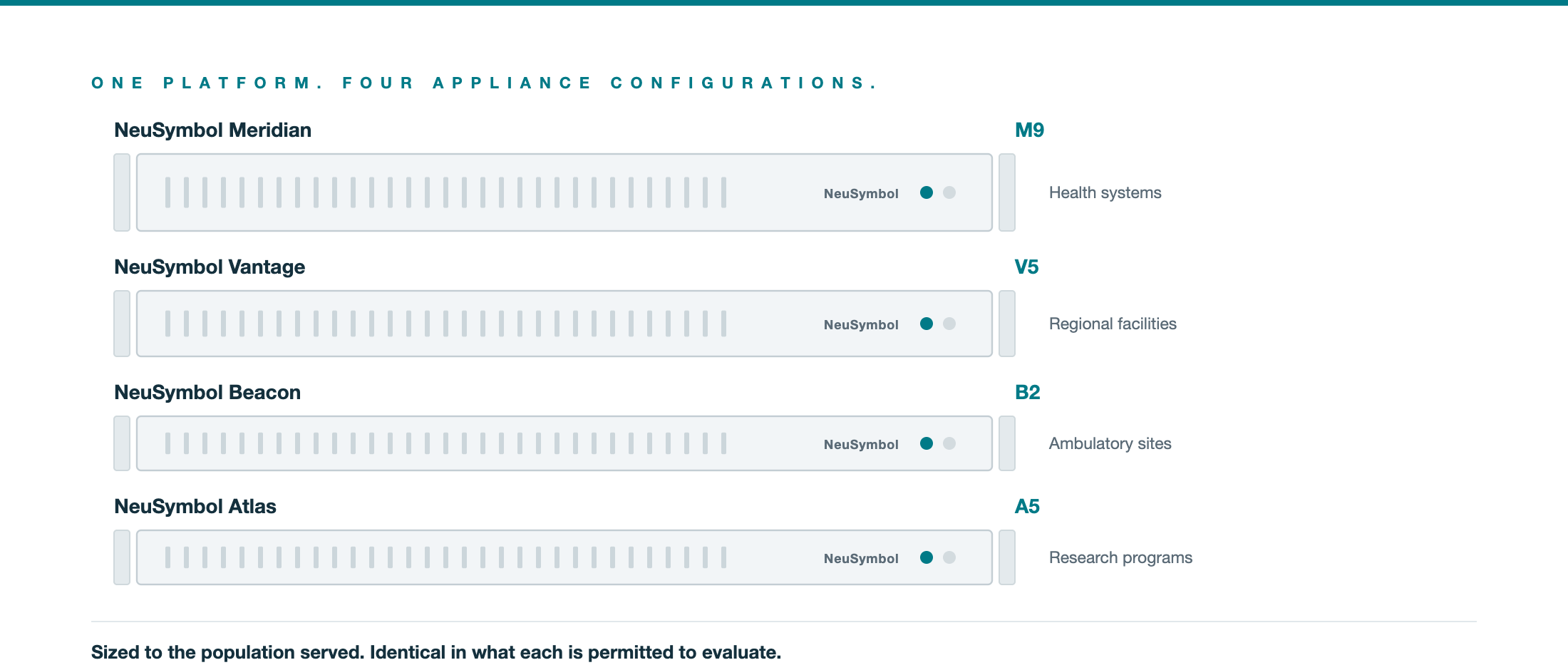
NeuSymbol is supplied as a rack-mounted clinical compute appliance in four configurations. The configurations differ in the volume of work each carries. They do not differ in what each is permitted to evaluate, and there is no reduced-capability edition for smaller institutions.
Compute internals are not published. They are provided in full to an institution’s technical evaluators under mutual non-disclosure, together with the capacity, power and environmental figures required for rack planning. What appears below is what a facilities and security team needs to decide whether the equipment can be accommodated and reviewed.
Common to all configurations
| Networking | Outbound only. No inbound firewall exception required. Full offline operation supported where policy requires it. |
| Storage | Encrypted at rest. Key custody remains with the institution. Reltronic holds no copy and has no means of recovery. |
| Physical security | Separately powered processing partition. Tamper detection destroys encryption keys, rendering resident data unrecoverable. |
| Patient isolation | Working memory cleared between individual patient evaluations. |
| Integration | Read access over standard health information exchange interfaces. No schema change, no migration. |
| Compute specification | Provided under mutual non-disclosure during evaluation. |
NeuSymbol Meridian M9
Clinical Compute Appliance for health systems and academic medical centers. Serves multiple affiliated sites from a central deployment, with the deepest retained clinical history of the family.
| Deployment scope | Multi-site. Serves affiliated facilities from a central installation. |
| Concurrent solutions | All platform solutions, running simultaneously. |
NeuSymbol Vantage V5
Clinical Compute Appliance for regional healthcare facilities. Sized for an independent hospital or a small network operating its own record system.
| Deployment scope | Single facility, or a small network under common governance. |
| Concurrent solutions | Multiple solutions, sized to facility volume. |
NeuSymbol Beacon B2
Clinical Compute Appliance for rural, critical access and ambulatory care sites. Built for equipment rooms that are not data centers and for connectivity that is not guaranteed.
| Deployment scope | Single site. Designed for environments with limited IT staffing. |
| Connectivity | Operates indefinitely without an external connection. Updates applied through a controlled offline process. |
NeuSymbol Atlas A5
Research Compute Appliance for sponsors, clinical research organizations and registries. Generates comparison cohorts and real-world evidence.
| Deployment scope | Research programs. Cohort and registry scale. |
| Cloud working | Supported for exploratory analysis. Evidence intended for regulatory submission is generated on the appliance, because a cloud pipeline cannot produce the attested provenance record a regulator requires. |
Which configuration fits
Configuration follows from the clinical objective, not from institution size alone. A short conversation is usually enough to establish it.