What NeuSymbol is
NeuSymbol is clinical computing infrastructure installed inside the hospital that operates it. It treats the body as a system in motion rather than a series of snapshots. Instead of asking whether a single value is abnormal, it reads how a patient’s physiology is changing across encounters, and presents that trajectory with every contributing result attached.
It is a reference, not an alarm. Nothing is pushed at anyone. A clinician who wants to understand a pattern opens NeuSymbol and interrogates it, the way they would open any other reference on the ward. What they find is a trajectory and the evidence beneath it, and what they do about it is theirs to decide.
It is disease-agnostic. The same architecture serves oncology, metabolic medicine, psychiatry, rheumatology and critical care by adapting its clinical parameters rather than being rebuilt. One engine, many specialties, one installation.
Every result is bounded by physiology. NeuSymbol cannot produce a trajectory the body could not produce, because that limit sits in the mathematics rather than in a filter applied afterward. It shows its reasoning, and the clinician decides what it means.
NeuSymbol is a private clinical computing environment installed within the institution that operates it. It is commissioned once, extended with additional capability as clinical needs develop, and constructed so that patient information has no route out of the building at any point in its operation.
Infrastructure, not a subscription
NeuSymbol is equipment rather than a service. It is installed in the institution’s own data center, alongside the imaging reconstruction systems, laboratory analyzers and archiving systems that already process patient information on the premises, and it operates entirely under institutional control and institutional access policy. Nothing about its operation requires an outbound connection, and nothing about its architecture assumes one is available.
That distinction is not a technicality, and it is usually the first thing an institution’s security and legal teams establish. It determines the scope of the security review, the terms that have to be negotiated, the jurisdiction in which patient information resides, and where liability sits in the event of a breach. A cloud service, however well engineered, asks an institution to accept a new location in which its patient information exists. NeuSymbol creates no such location, which is why for most institutions it reduces the audit surface rather than enlarging it.
The platform is commissioned once. Additional capability is enabled against the same installed footprint as clinical priorities change, which means an institution that begins with a single question does not face a second infrastructure decision or a second security review to address the next one. Most institutions begin with one clinical service and extend from there.
Five capabilities
It reads what is already written
Clinical narrative, nursing documentation, structured results and, where available, genetic information are read together as a single patient picture rather than analyzed in separate silos. Nursing documentation matters here more than most systems allow for, because concerns are frequently charted by nursing staff several encounters before they appear in a physician’s assessment. No change to existing documentation practice is required, and no new fields are introduced for clinical staff to complete.
It looks across time, not at a moment
The platform compares a patient’s encounters against one another and reports the direction and rate of change across them. This is the mechanism by which a patient whose individual results are each unremarkable, and whose trajectory is not, becomes visible. A value that has moved consistently in one direction across two years while remaining inside its reference interval carries information that the same value, read once, does not.
It works where there is no precedent
Because it applies established medical knowledge rather than relying solely on local case history, the platform produces useful findings at sites that have never seen a given condition before. Rural and community settings are not second-class deployments.
It is deterministic, not probabilistic
The same record produces the same result every time, with no run-to-run variation to explain away. More than that, every result is bounded by physiology: the platform cannot return a trajectory the body could not produce, because that limit sits in the mathematics rather than in a filter applied afterward. A finding can therefore be replayed and audited rather than merely described, which is what makes independent clinical review meaningful rather than nominal.
It holds itself to what biology permits
The platform cannot produce a result that the human body could not physically produce. This is why its findings are suitable for regulatory consideration and why its projections can be defended rather than merely reported.
Solutions on the platform
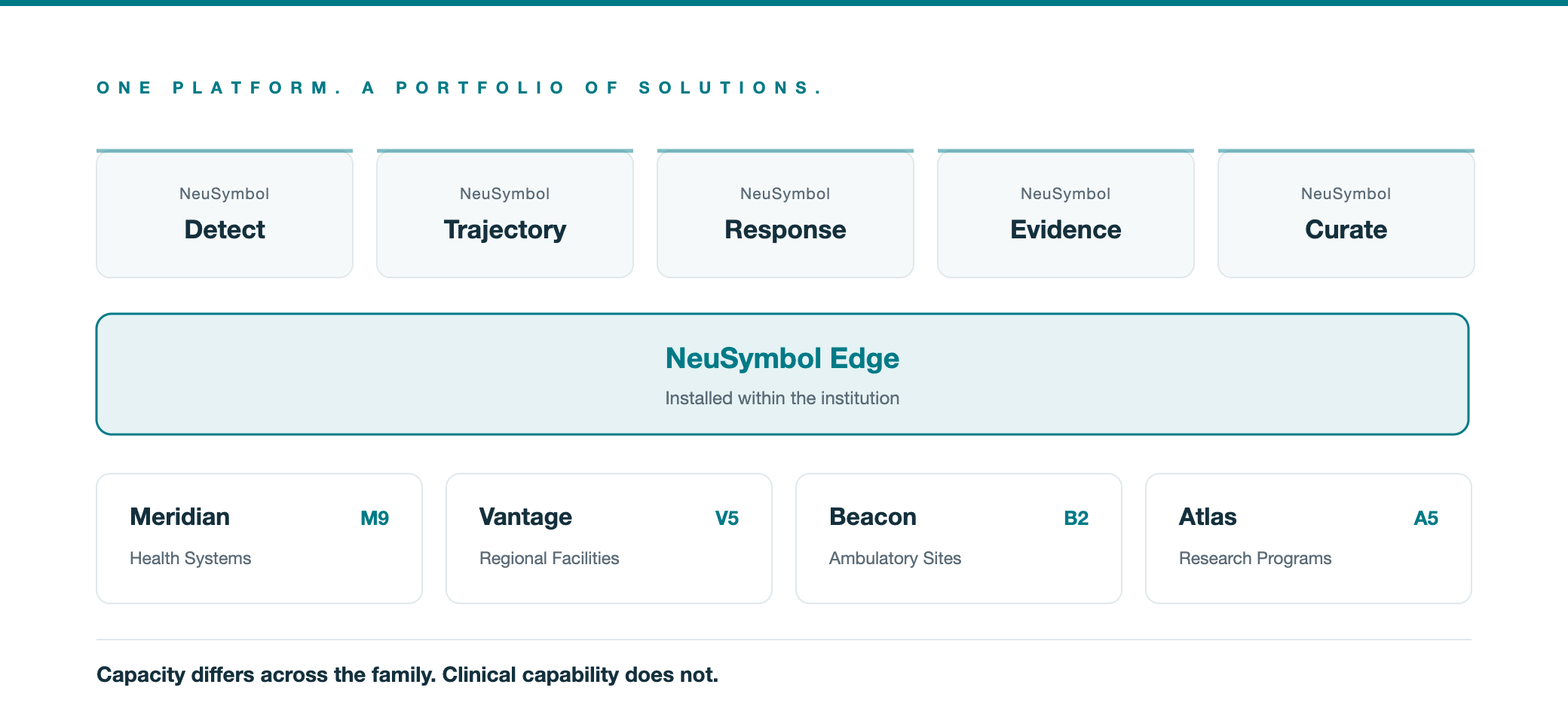
Most institutions begin with a single solution addressed to a defined clinical question, and extend to others against the same installed footprint once the platform has demonstrated itself against their own patients.
NeuSymbol Detect
Broadens the differential for patients who remain unresolved after repeated evaluation, bringing forward considerations that warrant exclusion, together with the observations that prompted each one. It applies established medical knowledge rather than local case volume, so it performs at institutions that have never encountered a given condition.
NeuSymbol Trajectory
Reads the rate at which a patient’s condition is changing across successive encounters and presents that trend for clinical review, rather than reporting each encounter against a fixed threshold in isolation. Patients with an attenuated physiological baseline can lose considerable ground without ever crossing a conventional limit, and this is the case the module was built to make visible.
NeuSymbol Response
Surfaces patients whose response markers diverge from the treated population, with the supporting observations attached, so that a therapy which is not producing benefit can be reassessed. It also distinguishes a therapy that is failing from one that is being neutralized before it reaches its target, which are clinically different situations that present identically in a chart.
NeuSymbol Evidence
Constructs comparison cohorts and real-world evidence to the documentation standards regulators expect, including full provenance for every transformation applied. For sponsors, the practical effect is a defensible external control arm and fewer patients required to receive placebo.
NeuSymbol Curate
Converts fragmented registry, survey and natural history data into structured datasets suitable for regulatory submission, with the curation record retained alongside the data. Ownership of the underlying data remains entirely with the organization that gathered it.
NeuSymbol Edge
The installed infrastructure layer, the private clinical computing environment itself.
Where the platform is applied today
The platform is not organized by specialty. It is organized around a kind of patient that appears in all of them, rare, complex, fast-moving, not responding to therapy, or simply unresolved.
Oncology
Difficult-to-treat and refractory disease, and patients whose response to therapy diverges from what was expected.
Infectious disease
Complex, resistant and atypical presentations, and treatment courses that are not achieving their intended effect.
Metabolic and inherited conditions
Presentations where routine chemistry stays within range while the patient’s trajectory deteriorates.
Neurology and psychiatry
Progressive and treatment-resistant conditions where rate of change matters more than status at any single visit.
Hepatology, critical care and multi-system
Complex presentations that fall between services, and gradual physiological drift preceding an acute event.
Research, population and one health
Evidence generation, preclinical work, population surveillance and veterinary and one-health applications.
Why the architecture matters
Comparison reflects publicly documented approaches as of July 2026. Individual capabilities vary by vendor and configuration.
| NeuSymbol | Cloud analytics platforms | Text-screening tools | Federated computing platforms | |
|---|---|---|---|---|
| Where patient data goes | Stays in the institution | Extracted to a vendor cloud | Varies; commonly hybrid | Stays local |
| Works with very few cases | Yes | No | Requires large text volumes | No |
| Looks across time | Yes | Historical snapshots | Single-document review | Depends on the model supplied |
| Includes clinical knowledge | Yes | No | Limited | Not supplied |
| Output built for regulatory review | Yes | Partially | No | No |
| Requires a human reviewer for every result | Reduced | Analyst-mediated | Yes, typically a review board | Depends |
| What the institution installs | Equipment | Nothing | Software or a connection | Software |
See it against its own questions
Briefings are run by the team that built the platform and are scheduled directly.