Built for patients with rare, complex, and treatment-resistant conditions across all specialties.
Some patients go years without an answer. Dozens of visits. Tests that keep coming back normal. Almost always, the information needed was already in the record, scattered across years and services, and never read as one picture.
NeuSymbol™ reads it as one picture. It broadens the differential, brings forward the conditions worth ruling out, and shows the evidence behind every one, so a clinician can check the reasoning instead of trusting it. It runs on equipment inside your hospital. Patient data never leaves the building.
It does not invent. Every result is bounded by physiology, so NeuSymbol cannot produce a trajectory the body could not produce.

Someone already noticed
In almost every delayed diagnosis, somebody saw it first and could not make it count.
The platform does not second-guess a clinical decision. It reconciles two things that are ordinarily read apart: what the record states across encounters, and how the patient’s biology has actually been behaving. Where those diverge, the divergence is presented with the contributing results attached, and the clinician decides what it means.
The nurse who charted the same concern on three separate admissions. The nurse practitioner four hours from the nearest specialist, holding results that are each individually fine. The pharmacist who watched a refill pattern change. The genetic counselor with a family history and no way to justify the referral.
They had the observation. What they lacked was the artifact, something that turns clinical instinct into a documented reason to act.
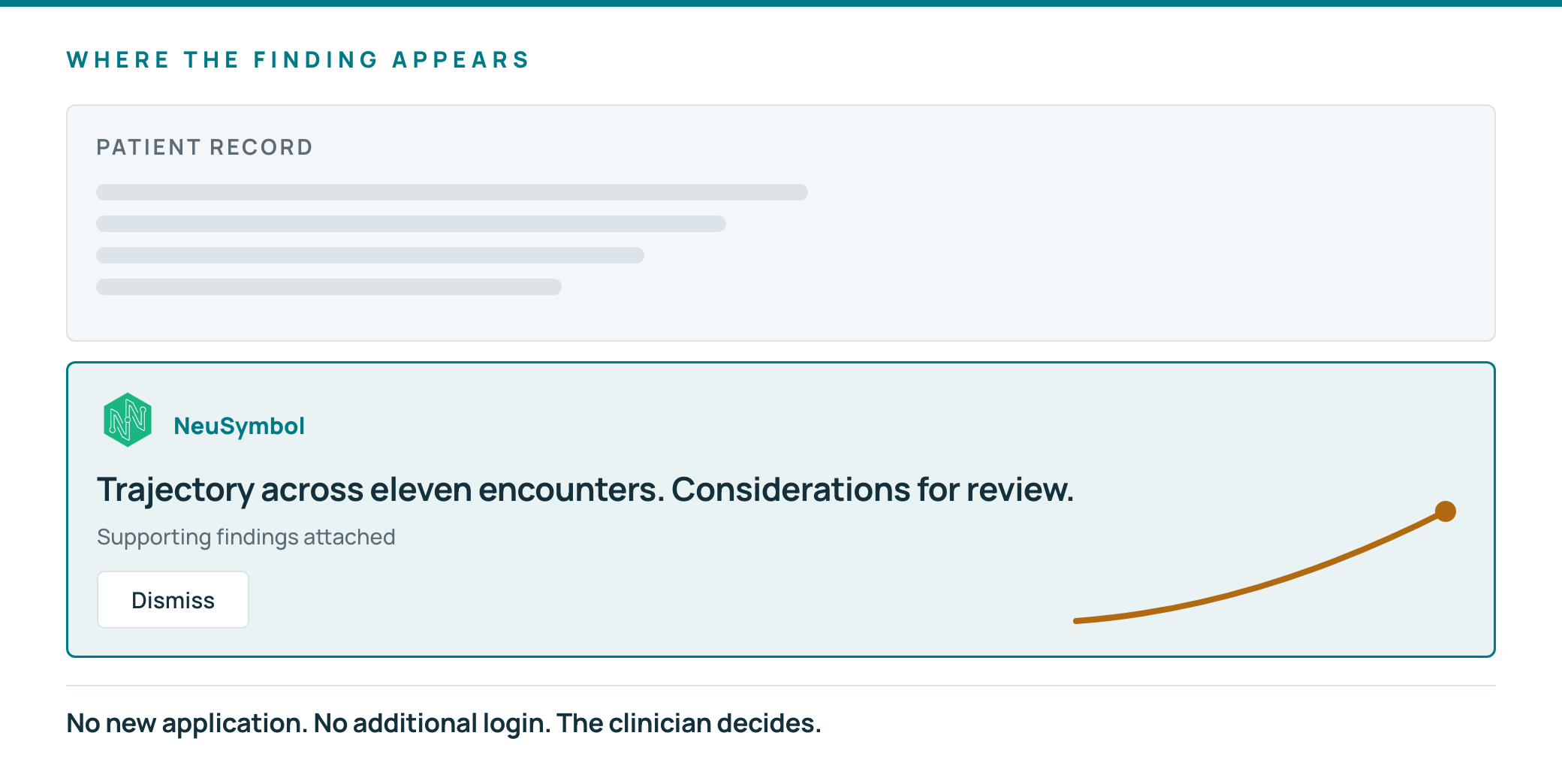
What the platform produces is not a verdict. It is a documented trajectory with the supporting observations attached, placed in the record where a clinician can act on it, interrogate it, or set it aside with a reason. The distinction matters, because a conclusion a clinician cannot examine is of no use in a case that has already resisted several rounds of examination.
The information was always there
Delayed diagnosis is rarely a problem of missing information. In the great majority of cases the information required to reach the answer was already present in the record, distributed across encounters, services and years, and was never assembled into a single view. What was missing was not data but adjacency.
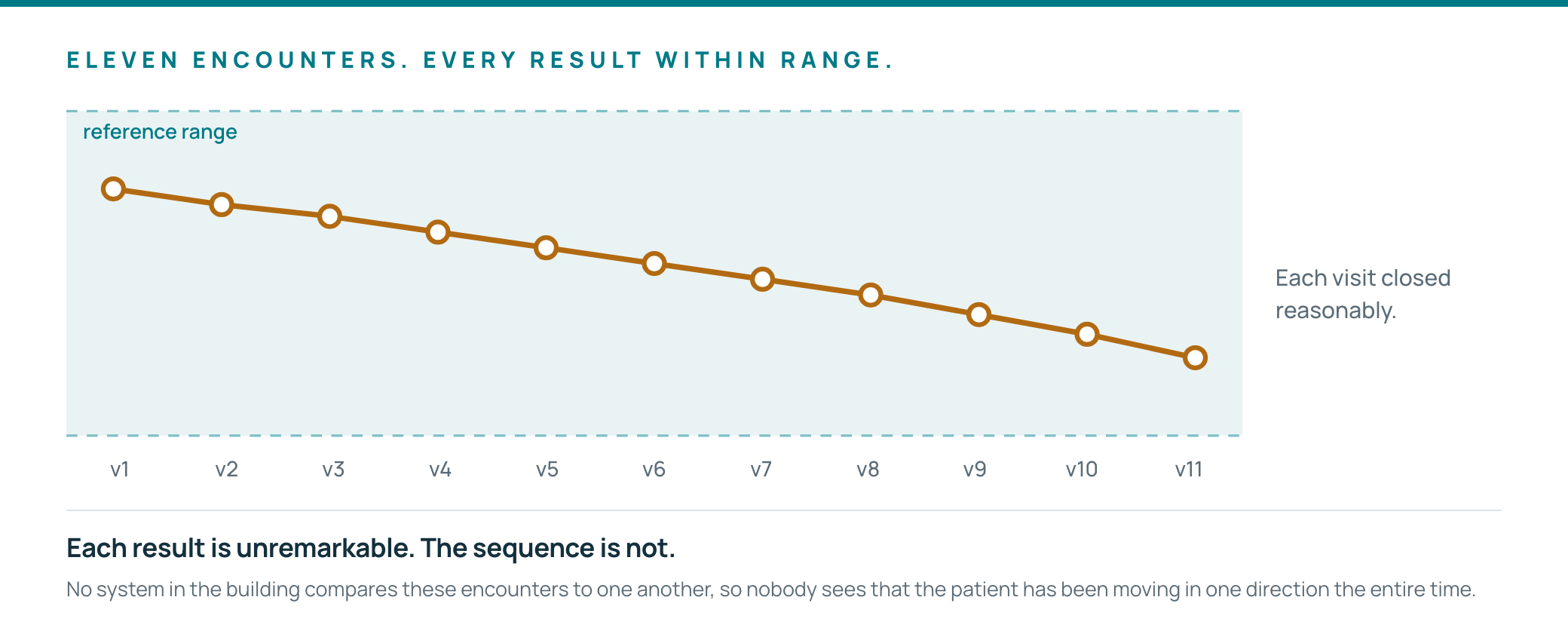
Consider a patient seen eleven times over three years by six different clinicians across three services. Each encounter is closed appropriately on the information available at the time, and each laboratory result returns within its reference interval. What no one observes is that across those eleven encounters the patient has been moving steadily and consistently in a single direction, because no system in the institution compares an encounter against the ten that preceded it. When the diagnosis eventually arrives, it is not the discovery of new information. It is a belated reading of information that was in the record throughout.
Conventional decision support cannot help here, and the reason is structural. Every conventional system is tuned to be reliable in the common case, so it is weakest exactly where the presentation is unusual, the condition is uncommon, or the patient is not behaving the way the guideline expects. NeuSymbol was built for the other end of that distribution.

The patients this was built for
Not a specialty. A kind of patient that exists in every specialty, and that conventional systems handle worst.
Rare conditions
Too uncommon for conventional analysis to have learned from. The platform applies established medical knowledge, so it performs at sites that have never seen the condition.
Complex presentations
Multi-system pictures that resist evaluation by any single specialty, and that fall between services rather than within one.
Avidity, or high-velocity disease
Avidity is the measured rate at which a patient’s findings change across encounters. Where avidity is high, the direction of travel matters more than any single measurement, and waiting for a threshold to be crossed means waiting too long. The platform measures it, shows every contributing result, and leaves the judgment to the clinician.
Non-responders
Patients on high-cost therapy that is not working for them, frequently for months or years before anyone establishes it. Both a clinical failure and a financial one.
Difficult to treat
Treatment-resistant, refractory, repeatedly readmitted, or simply unresolved after many encounters with many clinicians.
In every specialty
Oncology, infectious disease, metabolic medicine, neurology and psychiatry, hepatology, critical care, and beyond. These patients are a small share of any panel and a large share of its cost and its difficulty.
How can we help?
The patients are the reason. You are the people who can do something about it. What that looks like depends on where you sit.
If you are a clinician
You will not be second-guessed. Nothing interrupts you, nothing is added to your documentation, and every finding arrives with the observations that produced it so you can check the reasoning rather than trust it. Anything can be dismissed, with or without a reason.
If you run a health system
One installation serves every service line, and the capability at a rural site is the capability at the academic center. Because patient data never leaves the building, your audit surface gets smaller rather than larger.
If you are in security or IT
For an installed clinical system there is no cloud service to assess, no processor to add to your register, no cross-border transfer to justify and no patient data egress to monitor. Most evaluations end shorter than they start.
If you develop therapies
Comparison cohorts built to the evidentiary standard regulators expect, which means fewer patients receiving placebo and a defensible external control arm.
If you carry the risk
High-cost therapy matched to recorded response, so the patients a drug is not helping are identified while something can still be done for them.
If you are somewhere else
Care teams, health systems, biopharma, research organizations, payers, pharmacy networks and patient foundations. The platform does different work depending on where it sits.
Or just talk to us. Briefings are run by the people who built the platform.
A structured evaluation
An evaluation runs against the institution’s own historical records, so the result is specific to its patients rather than to a reference population. Commercial terms are discussed directly, once an institution has seen what the platform surfaces in its own data. The written analysis of its own population is delivered either way, and remains the institution’s property.
The structure is deliberate. An institution should not be asked to commit to clinical software on the strength of another institution’s results, and the patients this platform is built for are distributed too unevenly for published figures to mean much anywhere else.
Weeks 1 to 5
Scoping and installation. The clinical question is agreed, the sources in scope are defined, and the equipment is commissioned in the institution’s own server room. Security review begins at the start rather than at the end.
Weeks 6 to 10
Silent operation. The platform runs against live records without surfacing anything to any clinician. No workflow changes, and no one is asked to do anything differently.
Weeks 11 to 13
Review. Findings from the silent period are examined retrospectively against known outcomes, in the institution’s own patients, and presented in writing to clinical and executive leadership.
Where the institution elects to proceed, findings begin surfacing in workflow at thresholds its own clinicians set. Where it does not, the equipment is removed and the analysis remains the institution’s to use as it sees fit.
Three things NeuSymbol will not compromise
It runs inside the institution
NeuSymbol runs on equipment inside the institution, not as a service it sends data to. Patient information never leaves the institution that holds it, because no path exists for it to take. Clinical data remains in its own data center, under its control and on its terms.
It cannot invent
Every result is bounded by physiology. The platform cannot produce a trajectory the body could not produce, because that boundary sits in the mathematics rather than in a filter applied afterward. The same record returns the same result every time, with no sampling and no run-to-run variation to explain away. This is why its findings hold up under scrutiny.
It shows its work
Every result carries a complete, tamper-evident record of how it was reached. Because the reasoning is bounded and repeatable, it can be replayed and audited rather than merely described. Nothing is asserted without the evidence that supports it, and nothing is asked to be taken on faith.
One platform. A portfolio of solutions.
NeuSymbol is infrastructure, installed once and extended over time. Institutions typically begin with a single solution and add others against the same footprint.
NeuSymbol Detect
Broadens the differential for unresolved patients, bringing forward considerations worth ruling out, including at sites that have never seen the condition before.
NeuSymbol Trajectory
Measures avidity, the rate at which recorded findings are changing across encounters, and presents it with the contributing results attached for review.
NeuSymbol Response
Identifies non-responders, patients for whom a high-cost therapy is not working, so treatment can be matched to the people it actually helps.
NeuSymbol Evidence
Produces real-world evidence and comparison cohorts built to the standards regulators expect, reducing the number of patients who must receive a placebo.
NeuSymbol Curate
Converts fragmented registry and survey data into validated datasets suitable for regulatory submission.
NeuSymbol Edge
The installed infrastructure itself, a private clinical computing environment operating entirely within the institution.
For information technology and security teams
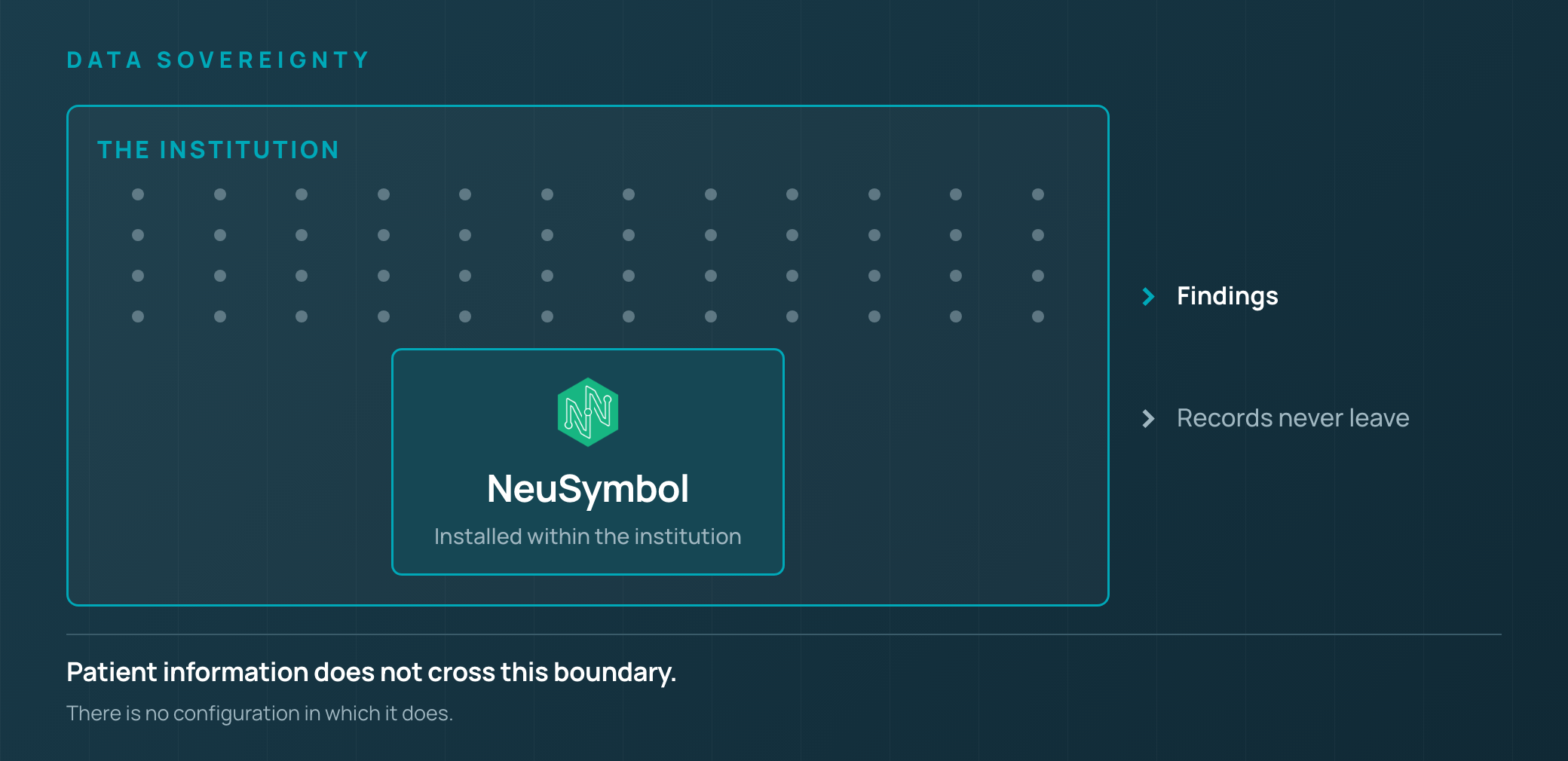
NeuSymbol adds no new location in which patient data can reside.
There is no data processor to add to a register, no cross-border transfer to justify and no patient data egress to monitor. The equipment sits in its own rack, alongside the other clinical systems already processing patient information on-premise, and operates in a fully isolated configuration where that is required.
It is the only option on most evaluation lists that makes an institution’s audit scope smaller rather than larger.
What Reltronic and NeuSymbol will not do
Reltronic does not sell patient data. Reltronic does not hold patient data. Reltronic does not move patient data.
NeuSymbol does not replace clinical judgment. The platform advises. The licensed professional decides. That boundary is absolute and it is not a configuration setting.
Reltronic does not compete for routine analysis of common conditions at scale. Established organizations serve that need well, and the platform is not built for it.
NeuSymbol does not ask anyone to trust a result they cannot examine.
Start with the questions, not the pitch
Briefings are conducted by the people who built the system, and are best attended by clinical leadership, the security team, and whoever is least inclined to believe any of it.